Tuesday, August 31, 2010

Dylana Jenson

Dylana Jenson's new release of the Shostakovich and Barber Violin Concertos has been entered for a Grammy nomination. I've been inspired by Dylana Jenson's violin playing since the early 70's, as a child growing up in the suburbs of Boston, where I first began music studies. Dylana had such reknown as a child prodigy, that sometimes after my own concerts, audience members would rush to congratulate me, and say how much they enjoyed my appearances on "The Tonight Show". Finally, it became so awkward and uncomfortable for me to clarify that a). The young violinist was not me but another child violinist, Dylana Jenson, and b). Her career had sky-rocketed, and I was still working my way up. I left well enough alone. We were both young female violinists with dark hair and brown eyes. I accepted any praise and acknowledgement meant for her.

Our paths crossed briefly in the mid-70's, when I relocated for studies with Jascha Heifetz in Los Angeles. My parents, determined to have me meet this young lady at last, telephoned her family in Sherman Oaks, and they invited us for a visit. What a warm reception we were granted by the entire family, I'll never forget. But, as I was urged to take out my violin, and prove my worth, I was gripped by stage fright. I cannot recall what I served up that evening. I do remember that Dylana opened her violin case and nonchalantly played for us, unaware of the pressure cooker scenario. The music seemed to pour from her soul right into her fingers. I was envious, but at the same time, inspired.

Years later our paths met again. But this time, I was a newly elected section player of the Los Angeles Chamber Orchestra, and she was the star soloist performing Samuel Barber's Violin Concerto. The orchestra  admired her playing, so expressive and masterful. In those days I had been borrowing a Carl Becker violin, but was ordered to return the loaned instrument after being hired by LACO. Fair enough. But it never occurred to me that Dylana Jenson had to return the 1743 Guarnerius del Gesu (that was on loan to her by the same collector) for the reason that she got married, at age twenty-one to conductor, David Lockington.  Dylana tells her story here in a captivating interview on violinist.com with Laurie Niles.

I love this recent release of the Shostakovich and Barber Violin Concertos. Jenson displays her keen sense of dramatic intensity and fiery command in both concertos with London Symphony Orchestra conducted by David Lockington. She is an impassioned violinist who displays rich, tonal beauty and shows remarkable instinct for stylistic nuance. The haunting, pervasive anguish in Shostakovich's music paired with the lyrical and velvety Barber (with its hair-raising finale) demonstrate the triumph of a one-of-a-kind violinist, the owner of a  signature sound and breathtakingly flawless technique. Dylana Jenson has my vote.

Sunday, August 22, 2010

Celebration of Life for George Shangrow

Today I attended the Celebration of Life service for George Shangrow, Seattle's musical dynamo, killed in a car accident on July, 31, 2010 at the age of 59. The turnout at University Christian Church was staggering. The church was filled to capacity. An over flow of mourners crowded all the way upstairs to the balcony—some were left to stand for the duration. With his immense talent, love and enthusiasm for music, the ability to communicate with audiences of all ages from diverse backgrounds, George Shangrow brought light to the hearts of many.

Now, at the age of 51, I have become increasingly aware of the finiteness of life. Every day is precious, for we never know when it will be our last. With each death or parting, a deeper meaning attaches itself to life; a new revelation comes into focus. What struck me about George, as I listened to the shared musical experiences and remembrances, was how steadfast and loyal he was as a friend and colleague.

I'll always remember him as a most gracious host on his radio show, KING-FM's Live By George. Lou Magor, a pianist and friend, shared that with his wealth of knowledge, expertise, and quick intellect, George could easily have upstaged, or stolen the spotlight from any guest on his show. But he never did. I remember feeling jittery for my first appearances with him on the radio. As a young performer, I had been encouraged to do less talking and more playing. One of my teachers, Heifetz in particular, would become impatient with any explanation that resembled a dissertation, so I hesitated to speak about music in public. But with George, my fears were groundless. I merely had to give him that certain look in the studio, a look which signaled, let's not go there—and he deftly switched the topic with just the right dose of humor.

He had an almost childlike, naive trust in others. Betrayal from a colleague hit him hard and was unfathomable. While former KING-FM radio host, Tom Dahlstrom, shared reflections about the sixteen years he enjoyed as a co-worker with George at the station, he mentioned the two times that he had detected a quiver in George Shangrow's voice. Fearless in front of the microphone, and also in front of audiences in the concert hall, his was the voice of calm. There was a quiver, though, as George recounted the horrors at Mauthausen, the notorious Nazi punishment camp, which he visited on more than one occasion. He sought to find answers to the atrocities, the senseless deaths, but found there were no answers, only more questions. George Shangrow, a man who lived and breathed joy in music, could not wrap his head around mankind's destructive urge and capacity to wipe away countless, innocent lives. It was inconceivable that prisoners at Mauthausen Concentration Camp had been exterminated with Beethoven's "Ode to Joy" playing in the background.

There was a quiver in George's voice when he received messages at KING-FM, through various e-mails, that his job was being terminated; he warned his friend and colleague Tom Dahlstrom of an impending, similar fate. As I listened to flautist Jeff Cohan, pianists Robert Kechley, Mark Salmon, and George Fiore perform at the memorial service, I realized that George valued his friendships and the people he worked with above all else; he wouldn't betray a colleague, although another person with the same initials might have no problem doing so.

The proof of George Shangrow's legacy was there today at the memorial service, and is all around us. George Shangrow's devotion to music lives on, through Orchestra Seattle and Orchestra Seattle Chamber Singers,  through the many live interviews and programs that he hosted, through his beautiful and talented daughter, cellist Daisy Shangrow, and the many inspired students from his classes at Seattle Conservatory. He enriched countless others by sharing classical music so freely with all, while making it accessible, and with the talent for inclusion rather than exclusion.

His friends quipped that George Shangrow loathed deadlines. Punctuality was not, well, his strong point even for a show live on the air. But with a trace of humor that echoed George, to the point that I could almost hear his voice:
He was early for once—but to his own funeral.

Monday, August 2, 2010

George Shangrow

Like many others, I learned of the tragic death of Orchestra Seattle and Seattle Chamber Singers music director, George Shangrow, through an internet discussion on Facebook. Reading the horrible news about one of Seattle's most gifted, but least valued artists, killed at the age of 59 is shocking and saddening, to say the least. Shangrow, former host of "Live by George" for KING-FM, was en route to deliver a pre-concert lecture on American classical music for the Methow Valley Chamber Music Festival, when a teenager lost control of his vehicle on Highway 20, due to a thundering rainstorm, and swerved across the center line which resulted in a head-on collision. The teen driver received injuries to his ankle and collar-bone; Shangrow was pronounced dead on the scene. His family was notified after the news hit the media.

I had the pleasure of working with George Shangrow on many occasions, both as a frequent guest on "Live by George," and as soloist and chamber music partner with Northwest Chamber Orchestra and Orchestra Seattle. George was such a great musician and intuitive accompanist that when I performed the Beethoven Violin Concerto with Orchestra Seattle in 2003, I sensed that we were on the same wave-length. And I had drawn a similar conclusion when we performed J.S.Bach's "Concerto in d minor" with the now defunct Northwest Chamber Orchestra, as well as a complete program devoted to the Bach family at Volunteer Park.

George Shangrow loved, and deserved to work with professional orchestras in this community, but he was given precious few opportunities around here for some dubious reason. I remember George telling me, after directing NWCO, that to conduct a professional ensemble was like driving a fine automobile. Indeed, I knew what he meant.

About a month ago, I was returning home from a day in Portland with my daughters Anna and Sarah. We were desperate for music, as my Eurovan is lacking a CD player, and the antennae is broken, which means, no radio either. Anna reached into a long forgotten pile of cassettes, and fed a mystery tape into the player. The charismatic and gracious voice of George Shangrow introducing pianist Dianne Chilgren and me as guests on his show to perform "Introduction and Rondo Capriccioso" brought back a host of memories. I was introduced as concertmaster for this and that, which I am no longer, and as artistic director for a series which has been long gone as the orchestra is now dead, by a multi-talented, extraordinary radio host that was shamelessly ousted by KING-FM. I switched off the radio station from that day on. The arts community had, once again, tried to silence a Seattle musical treasure who had brought classical music into so many households, and made it accessible for all.

George, you will be forever missed. Thank you for sharing your love and immense musical talent with all of us.

Sunday, July 11, 2010

Too much paperwork or politics?

My dear husband, Ilkka, sifted through this morning's Sunday edition of the New York Times, and, while I was still asleep, tossed an ad for Seattle Opera's summer production of "Tristan und Isolde" into the recycling bin. I discovered the ad in the late morning, as I was searching for some missing paperwork. You know how it is, when you wish to find one thing, you stumble upon another.

When I chanced upon Seattle Opera's flyer, I felt the pangs of grief and torment that "psychological warfare" produces for, as it has been pointed out by former colleagues, I have been treated as collateral damage. My husband  was Seattle Opera's concertmaster for over twenty years from 1984 until 2004, and I was a regular substitute first violinist during that time. After the illegal termination of employment of his concertmaster position by the Seattle Symphony, which came to a resolution through mediation, we were both assured that our livelihoods would not be compromised or imperiled, and that Ilkka and I would enjoy a continued working relationship with Seattle Opera.

In May of 2004, an e-mail from Mr. Jenkins. (Note that he is referring to the sudden termination of Ilkka's SSO contract):

Dear Ilkka,
----]I am shocked at your message. No one at the opera had any idea of this at all.
We do have a little bit of time before anything will happen in this area. We are in some ways tied to the Symphony and the players. On the other hand I am certainly happy with your work and very appreciative of the dedication you have always shown to Seattle Opera. We have also benefited not only from your leadership but mostly your superb playing, which is technically excellent and adapted to the different styles of whatever opera we perform.
Know that you have my trust and confidence. I will do some work on this and find out what I can. I so appreciate all that you have done, do and will do for the Opera.
Best,
Speight.


And here, a heartfelt letter which I wrote and sent to Mr. Jenkins in 2008. Unfortunately, Mr. Jenkins did not have the decency or courtesy to respond. Perhaps seeing this letter on my blog will jog his memory.

Dear Speight,
I am aware that you were placed in a difficult position regarding Ilkka's contract back in 2004, and it disturbed us both greatly. The Seattle Symphony and Gerard Schwarz treated my husband with complete disregard, as they deprived him of his career and livelihood without any warning or articulated basis. As you can imagine, these actions resulted in financial hardship and emotional duress to our family. Though his case was eventually resolved through mediation, a signed agreement stipulates that Seattle Symphony, Seattle Opera and their leadership refrain from all discriminatory behavior against Ilkka and me.
As you may recall, I was consistently placed on the hiring list for both Seattle Symphony and Seattle Opera in the first violin section, as a substitute, for as long as Ilkka served as concertmaster. I was regularly hired during summer opera productions. As of 2005, I have not received information with regard to orchestra vacancies, and have not been offered any extra work by Symphony or Opera. 
---We understand that during the year Seattle Opera is bound by an arrangement with SSO. However, the Opera summer production is a separate entity. I'm enclosing an exchange of e-mails between you and Ilkka dating back to 2004, where you praise his work, and assure him that he will work for you in the future---
I look forward to hearing from you.
Sincerely,
Marjorie Kransberg-Talvi


In summary, Seattle Opera is an organization that continues to fight for its survival. I believe it's crucial for donors—past, present and future—to learn about the internal politics.
photo of Speight Jenkins in his office © Rozarii Lynch

Wednesday, June 30, 2010

Bonne chance, Maestro Morlot

Like many others in town, I learned of Ludovic Morlot's appointment as Music Director Designate of Seattle Symphony beginning this fall through Daniel J. Wakin's feature article in The New York Times. I thought Mr. Wakin was clever to refer back to the local ensemble's enduring era of turbulence and upheaval during the quarter of a century reign under Gerard Schwarz. Mr. Morlot will need to rehabilitate and revitalize a group of disaffected musicians, that's for sure, and jolt the community out of its ennui.

Although I'm unfamiliar with this young French conductor, and have not yet attended a performance of his with Seattle Symphony as yet, I certainly hope he will prove  to be just what this local community has long awaited. Born in Lyons, France, 36-year-old Mr. Morlot studied violin at the University of Montreal and conducting at the Royal Academy of Music in London. He is sought after as a guest conductor, having appeared with Chicago Symphony, Boston Symphony and New York Philharmonic, among a long list of others. Morlot has been recognized as a "leader with a clear beat and precise ear" by New Yorker critic Alex Ross, acclaimed author of the book and blog "The Rest is Noise." Speaking as a violinist, I can appreciate a conductor who has intrinsic knowledge of string playing; articulations and phrasing might, for a change, become more natural and less forced. Wouldn't it be wonderful if an era of dot dash could be replaced with inspired phrasing, natural musicality, and originality?

Of course, the Seattle Symphony, like many other American arts organizations, has a strong desire to establish more of an international presence. A European conductor is often perceived as a catalyst for growth and opportunities abroad, such as touring. But these are troubled economic times, with ticket revenue and corporate donations down, as well as shrunken endowments. Boardrooms tend to be petri dishes for bad behavior. Ludovic Morlot has never had an orchestra of his own thus far, therefore, he will need to prove himself in this local community by cultivating his own pool of followers and donors. Morlot and his family will relocate to Seattle; a local presence might be helpful, although I think it's fair to surmise that every honeymoon period is short-lived, and Seattle has a tradition of dragging its feet when it comes to new leadership.

Music directors of American orchestras must dedicate an inordinate amount of time to fund-raising efforts. And, during this period of slow economic recovery, no matter what Michael Kaiser, the impassioned President of the Kennedy Center and arts organization guru touts in terms of turnaround technique, Morlot is taking the helm of Seattle Symphony at one of the most daunting episodes in recent history. I wish Ludovic Morlot and my colleagues bonne chance. Time is of the essence for a turn around. If there's a slush fund out there for lame-duck conductors, now might be the time to dip into it.
photo of Ludovic Morlot by Maike Schulz 2006

Saturday, June 19, 2010

Elegy

Sometimes, it takes a reminder for me to recognize my former incarnation as a concert violinist. When I stumbled across this YouTube video, I couldn't believe my ears, for I had forgotten my former self. I'm grateful to the individual who posted the Dohnanyi "Elegy" from the Piano Quintet recorded at the late Waterloo Music Festival in Princeton, New Jersey. My colleagues in this performance were violinist, Leonid Keylin, violist Jean Dane, cellist Eric Bartlett, and pianist David Montgomery.

It is really unfortunate when one person of influence misuses his power to squelch the voices of talented individuals, and tinkers with their livelihoods. There is nothing new to the art of blacklisting. And here, in Seattle, I'm sorry to say, the art form is alive and well. For those colleagues and friends who have reached out to share memories of past events and performances with me, I'm truly grateful. I'll be honest, there have been times when I have felt that it was all for nothing; the hours of practice, the dedication to perfection; the cloistered life. And I have experienced what it feels like to become disoriented from a loss of identity. But when I listen to Elegy, and hear the beauty of Dohnanyi's music, my spirits soar. Hope is rekindled; I love music; this love transcends all else.

My losses in performance opportunities have inspired me to compose a memoir related to my wonderful and rich life as a violinist. I have turned my creative energies into a wholly different art form. Although music is my first passion, I continue to discover the beauty and power of words. It never ceases to amaze me what the human spirit is capable of in the face of adversity. One can find laughter in sorrow.

I reach out to those of you who have met an untimely career death, or unexpected divorce from a world or role that you adored. It is my fervent desire that in the near future, those deserving souls who have been shunned and banished from the arts arena, will enjoy a right of return.

Friday, June 11, 2010

Rx for Violinists

With summer approaching, and as I reflect back on experiences in my youth, I remember how much of a challenge it was to adapt to the different styles and rigor of learning. As I explained to a lovely adult student last evening, who is making astonishing progress due to her quick analytical skills, there is not one single method, or cure-all that works for everyone, especially when it comes to playing the violin. The best training I received, over the course of my extensive years of study, was the encouragement to make discoveries and experiment on my own. 

I recall my first summer at Meadowmount School of Music, "a boot camp for budding virtuosos" and admit that at the age of eleven, I didn't have the slightest clue how to practice. On my music stand was the thick book of Kreutzer Etudes, a crucial but rather dry book. Years later, during studies in the Heifetz Masterclass, the Kreutzer book would be used as a Physician's Desk Reference. For bow tremor, etude number one might be helpful, but in small dosages. A string crossing disturbance could be aided by number thirteen. Shifting ailments were treated by a strong dose of  eleven and twelve. If the fourth finger experienced fatigue or weakness during trills, the eighteenth etude, practiced at regular intervals, would boost endurance and agility. And so on.

Recently, I have been introduced to another excellent resource for the intermediate to advanced learner. It is 12 Etude-Caprices in the Styles of the Great Composers by Meadowmount violinist and faculty member, Amy Barlowe. What I enjoy most about this collection, is that it reinforces practice tools for helping students learn and discover on their own. It is a wonderful complement to the Kreutzer because it doesn't taste like medicine but offers strong efficacy. Each etude-caprice livens the imagination with a focus on the stylistic differences between great composers, such as Sturm and Drang influence in Beethoven, changing meters in Ravel, and characteristics of Slovak folk music in Bartok. Ms. Barlowe includes concise measure for measure technical and musical practice guides, including improving intonation through the "stop bow" method and double-stop strategies.

There are wonderful illustrations and biographies about each composer, as well as chronological correlations with artists, writers, and historic events which encourages the student to contextualize musical styles. Most important, 12 Etude-Caprices in the Styles of the Great Composers is a curative for anyone who needs guidance during practice. I hope Ms. Barlowe might consider adding a piano accompaniment, or optional second violin, so that these etude-caprices can be included in the recital literature.

Tuesday, May 25, 2010

Finnish Goddess of the Violin

It's not everyday that I load up my Eurovan and head off to Portland, Oregon to hear a concert. But when I learned that the remarkable Finnish violinist, Elina Vähälä was to perform Benjamin Britten's Violin Concerto with Oregon Symphony, I knew to expect an unforgettable musical experience. I haven't been down to Portland for an Oregon Symphony concert since the era of conductor James DePreist, who left an indelible imprint on the orchestra and community.

With two of Ilkka's accomplished students, Rose McIntosh and Alyssa Fridenmaker, I had wonderful company for the three hour trek. We had an appointment for Rose to meet and play for Elina in the afternoon, to discuss a possible enrollment for the Hochschule fur Musik in Detmold, Germany, where she is currently professor of violin. The meeting turned out to be an invaluable lesson spent with Elina, as she shared insight into the concepts of synchronization between the left and right hands of a violinist, and the importance of clarity, articulation, and understanding of each note, particularly in its role and relation within the context of a phrase. As I sat and listened to the exchange between Elina Vähälä and Rose McIntosh, I couldn't help but wish for the Oregon Symphony to present her in a masterclass for young professionals in the near future. This was traditional, old-school teaching and playing at its best, but with a fresh twist, as described by Alyssa Fridenmaker. We left the conference room eager to hear Elina's performance of Benjamin Britten's Violin Concerto—a first time hearing for all of us.

After browsing at Powell's Book Store (of course!) and dinner at a Thai Restaurant, we returned to the Arlene Schnitzer Concert Hall. I had almost forgotten how much charm this original movie palace has with its ornate Italian Rococo design. The "Schnitz" was packed with an appreciative and enthusiastic audience.

A heart-warming welcome by Oregon Symphony's executive director Elaine Calder, with news of successful fund-raising for the orchestra to make its way to Carnegie Hall in 2011, was followed by an informative and engaging introduction to the rarely performed Britten Violin Concerto by Maestro Carlos Kalmar. The program began with a short work, Magnus Lindberg's "Purcell Variation". This piece felt like a mere curtain raiser, or teaser, to usher in the evening's soloist, Elina Vähälä.

Benjamin Britten, whose political views were very much of the socialist, pacifist, Left of the 1930's, wrote his concerto during 1938/39 as a requiem for the fallen soldiers of the Spanish Civil War, as well as a foreshadowing of World War II. It offers the violinist a sustained, dream-like main theme followed by a starkly contrasting, military quasi-cadenza. The tympani echoes the artillery of the military section. In a gypsy trio section, the intensive solo part is laden with furious, demanding passage work. The concerto concludes with a haunting and deeply spiritual lament. Britten invites the listener to hear and question the suffering of mankind by conveying an almost unspeakable sense of loss with his music. Elina Vähälä, with her incomparable command of the instrument, held the audience spellbound from the first note to the last. Her sound is expansive, varied and rich; she is a fearless violinist. The Oregon Symphony, under Kalmar's direction, accompanied the concerto with sensitivity and emotionalism.

Over the years, I've heard Elina Vähälä perform an assortment of solo repertoire, from Vivaldi to Shnittke, Mozart to Curtis-Curtis Smith, and frequently with her pianist/conductor husband, Ralf Gothóni. Every time I leave the concert hall with a similar impression, that being as if each composer wrote with her in mind.

Sunday, May 23, 2010

The Art of Possibility

There are many inspiring and meaningful messages from the best-selling book "The Art of Possibility" by Benjamin and Rosamund Zander. This book is a perfect antidote for helping one to survive in an overly competitive world. What's more, Benjamin Zander is Music Director for the Boston Philharmonic Orchestra. His techniques for experiencing a more purposeful and fulfilled life are gleaned from the vantage point of the conductor's podium. During his classes at the New England Conservatory, Mr. Zander encourages his students to place themselves in the future, and discuss their accomplishments in the past tense. This enables each student to feel as if they have mastered their goals and overcome fears. He has trained his students to lift their arms in the air, smile, and say "How fascinating!" after making mistakes. Mr. Zander teaches the art of risk-taking through music.

But what I especially love in "The Art of Possibility" is the game called "I Am a Contribution." In this game, you wake up each day and bask in the notion that you are a gift to others.It is a discipline of the spirit.

Today, as I attended the Seattle Philharmonic Orchestra's final performance of the season "The Brotherhood of Peoples" at Meany Hall, I was struck by the energy and vitality that this wonderful group displays under the leadership of Maestro Adam Stern, and the spirit of contribution by each member of the orchestra. To a near capacity house, the concert began with Elgar's "Introduction and Allegro", a most challenging work for strings. The Elgar offered the principal strings ample solo opportunities as a string quartet, and they rose to the occasion. Next on the program was the Concertino for Flute and Orchestra by Otar Gordeli. Simon Berry, the 2009 Bushell Concerto Competition Winner and senior at Roosevelt High School, performed this jazz-infused work with complete mastery and poise. Bartok's "Dance Suite" rounded out the first half with peasant melodies from Magyar and Romanian folk traditions and hints of Arabic styling.

The program concluded with Beethoven's Second Symphony. One could quibble about technical imperfections. In today's world, mainly through the miracles of technology, we've grown accustomed to an almost sterile, antiseptic performance manner where, to quote Zander, "the voice of the soul is literally interrupted." How joyful it was for me to hear music played with such warmth and expressiveness; the art of possibility at its best.

Saturday, May 22, 2010

For Peanuts, You Get Monkeys


I'll admit, when I read this article about Pasadena Symphony's financial woes, and Jorge Mester's refusal to take a pay cut for his salary of about $235,000 for roughly five concerts a year, I was taken aback by former board member, Jerry Kohl's comment: "They can find someone cheaper, but not somebody world-class like Mester. For peanuts, you get monkeys."

What a pitiful statement exposing a false mindset, especially in this country of ours. Today, when it comes to conductors and musicians, there's an embarrassment of riches, and short supply of opportunities. As I've said before, there are crops of talented artists going to waste here with employment opportunities diminishing. But this conviction, that only by offering an exorbitant salary to a conductor will an orchestra be transformed, as if by a Messiah, really grates on my nerves. I've worked with a number of talented musicians who are less well-known but stellar. One such young conductor who comes to mind is Darko Butorac, music director of Missoula Symphony Orchestra. His recent performances as guest conductor with Rainier Symphony and the Northwest Mahler Festival brought musicians practically to their knees, pleading for more opportunities to work with him. The level of intensity and inspiration Butorac drew from players was proof that skill level must not necessarily be equated with the all mighty pay check; fresh talent must be given a chance.

Which brings me back to this peanuts and monkeys philosophy. By this time, my small circle of readers know how much I love story-telling. Well, here's one. It appears to be teacher shopping time for many youngsters in Seattle. I've had a number of calls and e-mails from prospective violin students. Being a parent myself, and knowing that many families are struggling with finances, I keep my tuition to a rate that offers peace of mind, and let it be stated here, that I do not accept commissions for the sales of violins, as so many others in this town make a habit of doing. In other words, I can rest at night without feeling that I'm gouging students and their parents, as many colleges do when they raise their rates to appear more prestigious, while basically admitting anyone who can cough up the cash.

Perception of teaching ability is often mistakenly equated with tuition fee.  A non-musician father, while accompanying his daughter for an introductory lesson recently, asked me after the lesson for the amount owed. I stated my hourly rate. He looked at me dubiously. "That's all you charge? But, I thought you quoted a higher fee. Oh, I guess that was someone else—" I knew right then and there that his young daughter would be studying elsewhere, at a pricier studio, with one who is not lacking for greed, but perhaps for dedication and expertise.

After receiving a letter of rejection a few days after the lesson, I scratched behind the ears, climbed to the kitchen, and luckily, found a bag of peanuts.

Saturday, May 15, 2010

School for Scandals

"How did you get to be so creative?" asks my husband after reading the first installments of Frantic.

Here's my secret: I learned from the best of them. We had quite an education thirty years ago as members of the Los Angeles Chamber Orchestra. Not only was there a vast selection of repertoire to be played, everything from Mozart to Lazarof,  Bach to Bill Conti, but a rich supply of characters to make life interesting. Cupid slung her arrow at us, and we caused quite a stir. Our being together was a no-no and nobody expected us to last. But look at us now, thirty years later—

My husband and I take a stroll down memory lane.

The LACO was a 35-40 piece ensemble which played together on the average of one or two weeks out of the month. We performed regularly at Ambassador College in Pasadena, but also on campus at UCLA, and Claremont College. The orchestra gave run-outs in Palm Springs, El Cajon and Santa Barbara.The bus rides were especially memorable, as they afforded an opportunity for adolescent behavior.

The majority of players were comprised of many of LA's top studio musicians, including concertmaster Paul Shure, and his wife from Seattle, Bonnie Jean Douglas. After being hired at the age of 19, I sat last chair second violins, but was soon offered deliverance into the firsts, and promoted as soloist to appear with oboist Allan Vogel in J.S. Bach's Double Concerto. In those days, I played on a Carl Becker violin that caused grumblings from the first desk players; the violin sounded like a trumpet, and caused my playing to stick out rather than blend. Mean glares from those around me induced me to tears. Now I can laugh; this is memoir material.


There was a certain charm in being part of such a small musical family. Everyone knew everyone's business, and there was nothing more tempting and delicious than to help stir the pot. When one violinist claimed that her head was expanding in size due to a medical condition, we giggled in the bus, while making secret bets whether or not her head might explode. It was our great fortune that we had sympathetic bus drivers. They'd allow  the musicians to smoke weed in the back, and make frequent pit stops for beer. And, of course, there were liaisons; romantic interludes. I was so naive back then. I thought the whole concept of wife-swapping began in LACO. Remember the time we went on the 1980 Winter Olympics tour to Lake Placid and New York City?

The conductor, a ladies man, seemed like a decent guy back then. But then, appearances can be deceiving. Hormones fired up those concerts all right, and  it was truly a school for scandals.
In this photo in 1980 Margaret Moore, Gerard Schwarz, me and Jennifer (Woodward) Munday

Sunday, May 9, 2010

Mother's Day

It's been interesting to check in with a few of my characters for Frantic. Since I've lost touch with a number of colleagues from the East Coast and Los Angeles over the years, we've had some catching up to do. "What happened to you?" "Where have you been?" "Were you disappeared?" "But Schwarz is gone now, right?" And I remind my interrogators that 2011 is just around the corner. When the curtain lowers after the final act in a year, hopefully the curtain will raise to a new scene. But in the meantime, I try to answer the what, where and why questions with tact and good humor. But, in reality, I know that none of my characters have had their careers turned upside down.

It is not the end of the world to be discriminated against, though, because one has the potential to rediscover oneself. The ability to transform obstacles into opportunities might be empowering, even exhilarating. At least they are for me.

I'm ever so fortunate to be married to a person who is not easily intimidated. I believe a man displays inner security when he surrounds himself with strong, determined women. Now, in my fifties, I have observed that many males prefer the docile, demure type. That's not the case around our house, and for that, I'm grateful. Our daughters, Anna and Sarah, have been encouraged to think and speak for themselves. They are not confined to the boxes of their peers, and I'm proud of them.

Speaking of powerful women, I enjoyed reading the Chicago Tribune's recent article "How Deborah Rutter reeled in a classical music superstar"  about her sealing the deal for Chicago Symphony with Riccardo Muti. Back in the early 80's when I played as an extra for Los Angeles Philharmonic, I remember Deborah Rutter alongside Ernest Fleischmann. He had spotted her uncanny ability and talent for leadership already back then, and took her under his wing. She went on to become executive director of Los Angeles Chamber Orchestra.

Of course, Deborah (Card) Rutter is remembered and praised for her transformational abilities. A step in the ladder to her dizzying success in orchestra leadership was her stint as executive director of Seattle Symphony from 1992. It was then that the local band grew by leaps and bounds. She helped to revitalize the downtown arts scene with the building of Benaroya Hall in 1998. It might be food for thought that during the 25 plus years of Schwarz leadership, the Seattle Symphony has gone through, what, around ten executive directors? As for Rutter's comparison of Seattle to Chicago: "The air is a lot thinner up here, performing at this absolute pinnacle, which is really exciting because you have fantastic people come here, and you expect fantastic people to come here."

Muti says of Deborah Rutter: "The first important thing about Deborah is that she loves music. She's a woman of great personality, and at the same time, can be strong, and after one second, also charming. She can be deep, and at the same time have a great sense of humor that is very important in life."

All right. I'll make a toast: Here's to Mother's Day, and to all those women who refuse to be mice to men.

Tuesday, May 4, 2010

Evolving Icon

As I search for lost time in Frantic: the Memoir, I'm brought back to the years as a youngster growing up in the Boston area in the 60s and 70s. A highlight for me were Sunday afternoon concerts at the Isabella Stewart Gardner Museum, and of course, evening performances of the Boston Symphony and Boston Pops at Symphony Hall. It was through those experiences that I came to love music. The Pops reached out to all age groups, and made any performance an event not to be missed. To read how the Pops in its 125th season, is facing a decline in ticket sales, and looking for a way to evolve, as are the Cincinnati and Pittsburgh Symphony Pops, sadly reflects the current issues facing all arts organizations today.

Mark Volpe, managing director who oversees the Pops, Boston Symphony Orchestra, and Tanglewood, blames the struggles largely on the economy. But there are reasons beyond the economy for the decline. In the golden era of the Pops there was no Internet or cable TV to compete with. The orchestra could expect a core audience, no matter who was headlining the show. When the organization recently added "Pops on the Edge" a rock-themed programming, which brought rockers My Morning Jacket, Cowboy Junkies, and Guster, they alienated the older crowd. It's like damned if you do, and damned if you don't.
 "This is not your grandmother's Boston Pops," says Tony Beadle, who managed the organization from 1999-2006.

When I grew up, Arthur Fiedler was the legendary conductor of the Boston Pops. He turned the orchestra into the most popular symphony in the world, and advertised himself as a people's maestro. The Pops barely marketed but had an automatic audience, always. Arthur Fiedler turned another of his dreams into reality when he created open-air summer symphony concerts, free to the public, known as the Esplanade Concerts.

It's interesting and scary to be a classical artist of this time period, knowing that even the lighter concert series are suffering from lack of audience support and interest. Many of my colleagues seem distressed at the thought of their own children pursuing music as a career. What does the future hold? Will ticket sales go forward when the economy rebounds? And how should organizations market to the younger crowd while retaining older subsribers? The answers to these questions are anybody's guess.

I think some of the most prophetic words were spoken in 1974 by Harry Ellis Dickson, longtime associate conductor of the Boston Pops, in his revised book, "Gentlemen, More Dolce Please!" (Incidentally, Dickson plays a prominent role in my memoir, Frantic. I well remember how he was revered in the community for his wit and candor). As I leaf through Harry Ellis Dickson's books for second and third readings, I find them relevant for today:

"By the year 2000 all of us will probably have become so sophisticated and so saturated with music that all emotion will have been drained out of our systems. Concert-going will be an exercise in brain-function, nothing more. Perhaps it will afford a kind of satisfaction we don't quite understand today, but I'm glad I won't be around to "enjoy" it...
In the future we will continue to hurl invective at everything new and unfamiliar as we have done since before Beethoven's time. The good will remain, in whatever form, and the bad will be discarded in spite of ourselves."

Tuesday, April 27, 2010

Summer Capricorn

A fringe benefit to facing the unpredictability of life in classical music, due to the never-ending financial struggles and turmoil, is that I have time to catch up on my reading. The books I read are relevant for today, and I believe, years to come, as is the case with "Summer Capricorn".

Terry Row's first novel, "Summer Capricorn" is about Adam Nicholas, an acclaimed, professional oboist who has abandoned the uncertainty of the classical music profession in favor of a "real" job in computers. He desires a regular life with reliable hours. His choice is ill-timed, however. He embarks on his newly chosen career just as the recession hits Silicon Valley. Adam Nicholas, now desperate with the potential loss of unemployment benefits, must swallow his pride, and find a job—any job, to stay afloat.

"Summer Capricorn" is a captivating read on many levels. As I'm personally familiar with the author's stellar musicianship (we were both members of the Los Angeles Chamber Orchestra during the early eighties), I can relate to the frustration his protagonist shares as a free-lancer. The hours are erratic; the pace is abnormal; job security is job insecurity. When others work, we musicians play. But it is a common misconception that musicians' lives are play and not work. The truth is, that classical artists are so highly specialized that it is not uncommon for them to lose touch with the outside world. As Adam Nicholas admits: "I thought I was only good at one thing, playing music. I felt like a failure, an empty shell, when it came to the rest of my life. I wanted to see if I could do something else, anything else, and do it well."

What transpires in this marvelous tale are unexpected twists and turns as Adam opens himself up to new experiences and potentialities which are far outside of his comfort zone. While his desired career as a computer programmer is in limbo, due to the economic downturn, he has rolled up his sleeves and toiled in the land, as well as reached out to those in crisis. Adam is transformed by these experiences and renewed by a sense of awe and purpose. The world with all its mere "coincidences" takes on fresh meaning. He is awakened to different aspects of himself, as well as hidden abilities and talents. Adam beholds the Universe, with all its wonder, as if for the first time, and Life begins.

Monday, April 19, 2010

Close Encounters

With the weather turning delicious, I've been enjoying the outdoors. About a month ago, we had unseasonably warm temperatures for Seattle. My daughter Sarah and I decided to head for Green Lake. She needed to ease back into running, after a mild knee injury, and I felt determined to strap on my roller blades. It'd been years since I last rolled around the lake. I had to start slow—really slow, but after about 15 minutes, off I went.

You never know who you might bump into at Green Lake, in both the figurative and literal sense. It's a popular outdoor destination: family and pet friendly, and gorgeous. I remember once visiting the lake resort of Trakai in Lithuania, about 20 km outside of Vilnius, and thinking that Seattle's Green Lake is comparable in terms of scenic beauty. Although lacking the medieval stone castle of Trakai, which dates back to the 14th century, a historic relic from the local pit walked opposite my direction. Our eyes met; I kept my balance on the skates and kept on going. (Darn, a missed opportunity).

Allow me a magic moment of digression. To fulfill the obligation of playing first chair and as soloist for a dance company in the pit is unrewarding, to say the least. There is the paycheck, true, but little else. For those who have had close encounters with an audition, take my word for it, the pit band is a road that leads to nowhere; a musical dead end. If you're a violinist who adores music, and has strong artistic inclinations, just try to imagine performing Ernest Chausson's "Poeme" to a click track or Metro Gnome with thumping feet. The concept is probably alien to most thoughtful musicians, but this is a realistic comparison.

One finds soon enough, that dancers and most choreographers are painfully oblivious to interpretive style, and nuance. All that they desire is either a faster or slower beat, a quicker or later entrance, a longer pause. Therefore, it is perhaps sufficient, and even wise, to hire a conductor devoid of musical sensitivity on the podium, or better yet, no conductor and canned music. In all my years in the local pit, whether the repertoire demanded extensive or incidental solos, the offerings were lost to all thumpers, great and small.

Wednesday, April 14, 2010

Retirement (Not)

I have a great deal of admiration for violinist, Emanuel Borok. This morning I read his philosophy about stepping down from the concertmaster chair with Dallas Symphony Orchestra, after having served for twenty-five years. "Retiring is the wrong word," admits Borok. "I'm just making a change in my life. If you do this for 40 years, 39 of them as concertmaster, you get to the point that you want to do something else that you enjoy. I get more invitations to play concertos and recitals and chamber music than my schedule allows. This is another phase of my artistic life."

These are helpful words for any of us who have departed from an orchestral scene to full-time teaching.
Over the years, Borok's studio has thrived. "This is what I would end up doing anyway, so why not start building up a class now rather than at a later point?" Borok is on the faculty of both Southern Methodist University's Meadows School of the Arts, and University of North Texas. 

Seattle violinist Emily Cole, a former pupil of my husband's, is among Borok's current crop of students. She shares these thoughts about her mentor:  
The sound Mr. Borok produces on his violin is stunning. He is always searching for the most expressive bowing, the cleanest fingerings, and the best sound quality; he's always eager to share his discoveries with students. In teaching, Mr. Borok has developed a unique vocabulary to describe what he's after; he isn't merely recycling another person's explanations. Emanuel Borok cares for his students and is invigorated by teaching.

As I obsessively and compulsively edit Frantic the Memoir , chew my nails, and revisit scenes from my childhood, I have vivid recollections of both Emanuel Borok, who spent eleven years as concertmaster of the Boston Pops after emigrating from Moscow, Russia, and Joseph Silverstein, then concertmaster of Boston Symphony. It is heartening to know that both of these wonderful violinists continue to make themselves accessible to young musicians through teaching and concertizing. They are more active than ever; masters who serve as vital links from past to future.

My late violin teacher, Sarah Scriven, pointed out at a Boston Symphony concert, circa 1968, while I sat with her at the age of nine:
You know, darling. That Joseph Silverstein gets better all the time. He keeps improving with age.

That's the key.
cartoon by Kari Suomalainen, Finland

Friday, April 9, 2010

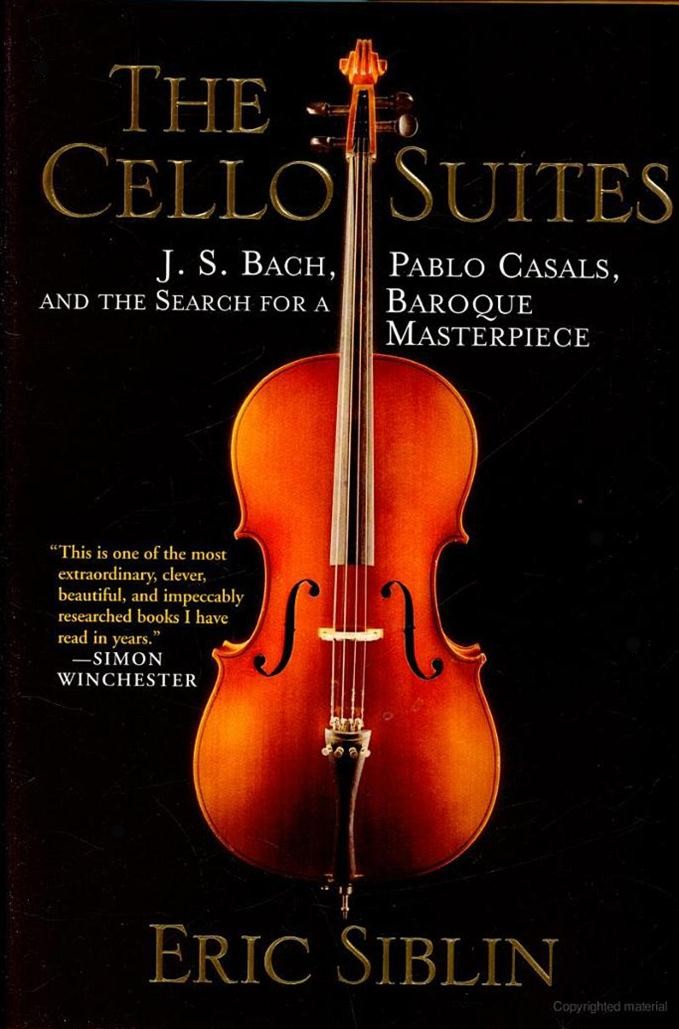
The Cello Suites

A note of warning to any string player who reads "The Cello Suites—J.S.Bach, Pablo Casals, and the Search for a Baroque Masterpiece" by Eric Siblin. You may experience a sudden desire to revisit the works of J.S.Bach, as if for the first time, after reading this engaging book, and wish to compare various artists in their interpretative quests to play this timeless music.

Eric Siblin, an award-winning journalist, filmmaker and former pop music critic braids together the lives of J.S.Bach and cellist, Pablo Casals, in a literary style that is immensely entertaining for music lovers and lay people. Like a set of nesting dolls, or boxes within boxes, the discovery of one tale leads to another; an attempt to solve the mystery of the manuscript's disappearance in the eighteenth century, Pablo Casals' historic discovery of the music in Spain in the late-nineteenth century, how passion, religious beliefs and political values shaped the lives of Bach and Casals, and finally, how the suites continue to thrive and evolve in the hands of various musicians, classical, jazz artists, and rock musicians alike. "The greatness of Bach's music," admits cellist Mischa Maisky, "is that it doesn't belong to any time or place."

After rummaging through a Barcelona music shop for sheet music at the age of thirteen with his father, and finding the mysterious manuscript in a dark corner, Casals played the suites every day for twelve years before gathering the courage to perform  them in public. Even in his nineties, Casals kept a routine of playing the Bach Suites beginning with the first suite on Monday, followed by the second on Tuesday, and so on. Casals explained to writer and peace activist Norman Cousins late in his life that Bach touched him "here"—and placed his hand over his heart.

This reminds me of the fierce determination violinist Joseph Silverstein demonstrated while offering up all six unaccompanied sonatas and partitas in performance. These one-time events, in honor of Silverstein's seventieth birthday, were presented as fund-raisers for organizations close to his heart; Northwest Chamber Orchestra among them. 

Mr. Siblin is aware that period police have not been impressed with Casals' style. "These hard-liners dismiss him as more Romantic than authentic" writes the author. Siblin makes a valid point by stating that audience  tastes have changed radically since the eighteenth century, and remaining open-minded to allow for today's listeners might not be a bad idea. From my own past experience, one critic, a Pippy Longstalker, trashed every performance that made use of modern instruments and vibrato. But then, maybe it caused too much static in her hearing aid.

Tuesday, April 6, 2010

Matzo Madness and Memories

Last day of Passover. One of our guests brought the most delicious matzo: Yehuda Matzos. Ordinarily, I avoid the stuff, as it tastes like cardboard, but this year, the matzo was magnificent. Maybe it was just a good batch, I don't know. Late at night, I wandered for forty minutes around the kitchen, poured a glass of Manischewitz, and slathered butter and strawberry jam on those beauties. The combination of crunchy matzo topped with creamy butter and sweet berries tasted like Nirvana. Truth be told, I'm not ready to return to toast.

Passover, a season of renewal, is also an opportunity for reflection and contemplation. While Sarah and I were driving home from shopping, I mentioned that we've lived in the same house on Queen Anne for twenty-five years. That's half my life.
"Did you expect to live here that long when you moved from L.A.?" my daughter asked.
"No," I said. As I turned into our carport, I had a Proustian experience, and recalled magic moments of lost time.

Over the years, in our humble dwelling, my in-laws, Irja and Veikko Talvi would travel from Finland, and transform our house into a palace. Irja polished the kitchen counters until they gleamed, and Veikko set massive historical books on our dining table. He rattled away on Finland's history in Finnish, as if I could process a labyrinth of information, and strained his ears to hear Ilkka practice. He listened to his son's recordings over and over again with Seattle Symphony, demanding to know which violin Ilkka played.
"A wooden one," was the only response from his son.

My mother, Frances Kransberg, doted on her grand-daughters, Anna and Sarah. She'd go out to our backyard in the late summer, and pick apples, pears and plums from the plentiful trees. Then she'd simmer the fruit together in batches, and create a rich sauce for the girls. The house smelled like cinnamon and cloves. Because her four daughters, myself included, led such separate and disparate lives, my mother wouldn't have her children in the same room with her at the same time until her passing, in 2004. The shiva ritual took place in our living room.

Music has always filled our home. Many talented individuals have enriched our lives within these walls. I remember when George Shangrow accompanied me at the piano with the Beethoven Concerto before an appearance with Orchestra Seattle. Playing the Beethoven with George felt effortless, as he's a wonderful accompanist. Incidentally, the day that George was no longer part of KING-FM, we stopped listening to that station—forever. I think classical KING-FM was doomed right then and there.

Back in the days of Northwest Chamber Orchestra, Adam Stern arrived to rehearse Copland's "Vitebsk" for an all American chamber music program. Vitebsk is chock full of quarter tones which confounded me; the tonalities posed a challenge. My husband slipped into the room, appeared at once by my side, and placed my fingers accurately on the fingerboard. Besides having perfect pitch, Ilkka had analyzed the quarter tone interval down to a science. What I didn't realize at that time, but I certainly do now, is that it is vital for a musician to keep an open mind (and ear) with regard to repertoire. We learn the most from our cherished colleagues.

Ralf Gothoni practiced on our Steinway upright, and beamed energy into our home. He mused: It's not enough to be young and talented like we, of course, are. We still must practice.

And, believe it or not, Ilkka and I were once threatened at this address by the SS. The police came right to our front door, sent by a local conductor claiming that my husband had jeopardized his life with his blog. Ilkka then showed his blog to the policemen, and they agreed, shaking their heads at false accusations: the opposite was true. Tainted matzo? Madness? Perhaps, but like the Exodus from Egypt, we remember.

Sunday, March 28, 2010

Gates of Freedom

We're down to crunch time before Passover, and like my daughter, Anna, says in her recent post, I'm a nervous wreck. If you saw my kitchen, and the mess scattered everywhere, you'd understand why. There are piles of papers which appear to proliferate right before my eyes, and boxes of leavened products which must be dispensed with in the remaining hours. Our water heater blew this morning in the downstairs kitchen; it almost felt as if the Red Sea had come to us! 

Pesakh, or Passover, commemorates the Israelites' escape from enslavement in Egypt. Jewish people throughout the world remember the importance of the event by eating special foods linked to the bitterness of bondage. We dwell on what it means to be liberated, beyond the Biblical event, during our Seder. This year, for the Haggadah, or narrative, each participant will have at his or her place setting Chaim Stern's "The Gates of Freedom". It is a beautiful book filled with wisdom from the sages. One Chassidic message particularly meaningful to me:
You cannot be redeemed until you see your own flaws, and try to correct them. We can be redeemed only to the extent to which we see ourselves. 
For it is all too easy to point out faults in others without recognizing the same faults in ourselves. My daughter Sarah reminds me that what we see in others is most often our own reflection.

Last Friday evening, I attended the SIFF theater (in association with Seattle Jewish Film Festival) for the presentation of: "Harlan—In the Shadow of Jew Süss" directed by Felix Moeller. Veit Harlan was one of Germany's most notorious filmmakers, having collaborated with the Nazis in the making of anti-Semitic propaganda films, including Jew Süss, which was required to be watched by every S.S. member. Mr. Moeller's candid documentary focuses on the shadow Veit Harlan cast on his children and descendants, and the stigma they have had to endure throughout three generations. While a few of Harlan's descendants (he was married three times) converted or married into Judaism, the most poignant interview and perspective was that of Thomas Harlan, the first born. Left with intense shame for the actions and unrepentant attitude of his father Veit Harlan, Thomas has led a life of relentless activism in support of Jewish victims, and others who have been demonized and oppressed. Certainly, he has loved his father, but Thomas Harlan has been the most vocal critic of his father's work.

In my opinion, Moeller's documentary "Harlan—In the Shadow of Jew Süss," is an excellent film for Passover. Besides dealing with the universal theme of guilt and responsibility, this film, though not explicitly, commemorates the Miracle of the First Born.

Thursday, March 25, 2010

Birth Announcement

So, we're eating lunch today, and Ilkka glances up from his plate, and asks, "Whatever happened to the memoir that you spent almost two years working on? Why don't you just go ahead and publish it?'
"Oh yeah," I said, having forgotten about my childhood memoir. "Too busy blogging, I suppose."
"But it's all written," he says with a glint of mischief in his eyes. "Your memoir is saved online on Google Documents. You could just publish your story in weekly installments, like the Russian writers of the past."
"I'm not sure. My memoir is so—juvenile."
"C'mon," he says. "You took all those writing workshops; what was the point in spending all that money? And it shows a different side to your life. It's your childhood perspective, after all."

I take a bite of the sandwich. The combination of dark rye, pickle, horseradish, dill havarti cheese, and peppered turkey fires up my imagination. Basket Case wine goes down smooth. I remember writing the memoir with the intention of giving it to my father as a peace offering, but he went and died before the completion. Just the same, I forged my way to the Epilogue.
I gaze into my husband's greenish eyes. How can I resist?
 "Ok," I say. "I'll do it."

Here it is. Frantic: the Memoir.
Here I am at age 6.