Friday, April 9, 2010

The Cello Suites

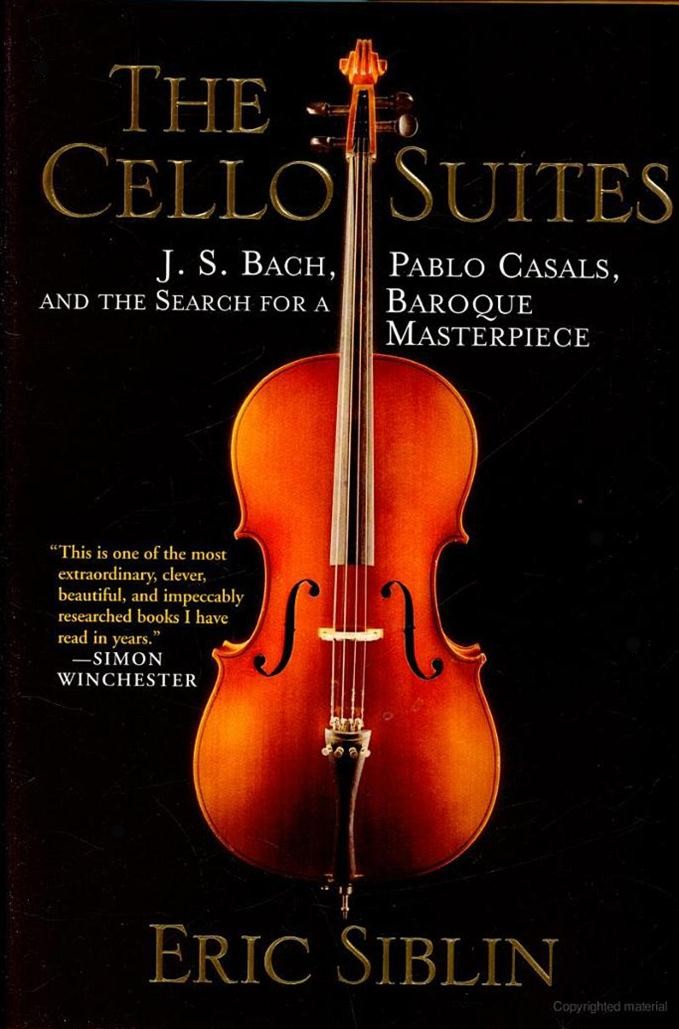
A note of warning to any string player who reads "The Cello Suites—J.S.Bach, Pablo Casals, and the Search for a Baroque Masterpiece" by Eric Siblin. You may experience a sudden desire to revisit the works of J.S.Bach, as if for the first time, after reading this engaging book, and wish to compare various artists in their interpretative quests to play this timeless music.

Eric Siblin, an award-winning journalist, filmmaker and former pop music critic braids together the lives of J.S.Bach and cellist, Pablo Casals, in a literary style that is immensely entertaining for music lovers and lay people. Like a set of nesting dolls, or boxes within boxes, the discovery of one tale leads to another; an attempt to solve the mystery of the manuscript's disappearance in the eighteenth century, Pablo Casals' historic discovery of the music in Spain in the late-nineteenth century, how passion, religious beliefs and political values shaped the lives of Bach and Casals, and finally, how the suites continue to thrive and evolve in the hands of various musicians, classical, jazz artists, and rock musicians alike. "The greatness of Bach's music," admits cellist Mischa Maisky, "is that it doesn't belong to any time or place."

After rummaging through a Barcelona music shop for sheet music at the age of thirteen with his father, and finding the mysterious manuscript in a dark corner, Casals played the suites every day for twelve years before gathering the courage to perform  them in public. Even in his nineties, Casals kept a routine of playing the Bach Suites beginning with the first suite on Monday, followed by the second on Tuesday, and so on. Casals explained to writer and peace activist Norman Cousins late in his life that Bach touched him "here"—and placed his hand over his heart.

This reminds me of the fierce determination violinist Joseph Silverstein demonstrated while offering up all six unaccompanied sonatas and partitas in performance. These one-time events, in honor of Silverstein's seventieth birthday, were presented as fund-raisers for organizations close to his heart; Northwest Chamber Orchestra among them. 

Mr. Siblin is aware that period police have not been impressed with Casals' style. "These hard-liners dismiss him as more Romantic than authentic" writes the author. Siblin makes a valid point by stating that audience  tastes have changed radically since the eighteenth century, and remaining open-minded to allow for today's listeners might not be a bad idea. From my own past experience, one critic, a Pippy Longstalker, trashed every performance that made use of modern instruments and vibrato. But then, maybe it caused too much static in her hearing aid.

Tuesday, April 6, 2010

Matzo Madness and Memories

Last day of Passover. One of our guests brought the most delicious matzo: Yehuda Matzos. Ordinarily, I avoid the stuff, as it tastes like cardboard, but this year, the matzo was magnificent. Maybe it was just a good batch, I don't know. Late at night, I wandered for forty minutes around the kitchen, poured a glass of Manischewitz, and slathered butter and strawberry jam on those beauties. The combination of crunchy matzo topped with creamy butter and sweet berries tasted like Nirvana. Truth be told, I'm not ready to return to toast.

Passover, a season of renewal, is also an opportunity for reflection and contemplation. While Sarah and I were driving home from shopping, I mentioned that we've lived in the same house on Queen Anne for twenty-five years. That's half my life.
"Did you expect to live here that long when you moved from L.A.?" my daughter asked.
"No," I said. As I turned into our carport, I had a Proustian experience, and recalled magic moments of lost time.

Over the years, in our humble dwelling, my in-laws, Irja and Veikko Talvi would travel from Finland, and transform our house into a palace. Irja polished the kitchen counters until they gleamed, and Veikko set massive historical books on our dining table. He rattled away on Finland's history in Finnish, as if I could process a labyrinth of information, and strained his ears to hear Ilkka practice. He listened to his son's recordings over and over again with Seattle Symphony, demanding to know which violin Ilkka played.
"A wooden one," was the only response from his son.

My mother, Frances Kransberg, doted on her grand-daughters, Anna and Sarah. She'd go out to our backyard in the late summer, and pick apples, pears and plums from the plentiful trees. Then she'd simmer the fruit together in batches, and create a rich sauce for the girls. The house smelled like cinnamon and cloves. Because her four daughters, myself included, led such separate and disparate lives, my mother wouldn't have her children in the same room with her at the same time until her passing, in 2004. The shiva ritual took place in our living room.

Music has always filled our home. Many talented individuals have enriched our lives within these walls. I remember when George Shangrow accompanied me at the piano with the Beethoven Concerto before an appearance with Orchestra Seattle. Playing the Beethoven with George felt effortless, as he's a wonderful accompanist. Incidentally, the day that George was no longer part of KING-FM, we stopped listening to that station—forever. I think classical KING-FM was doomed right then and there.

Back in the days of Northwest Chamber Orchestra, Adam Stern arrived to rehearse Copland's "Vitebsk" for an all American chamber music program. Vitebsk is chock full of quarter tones which confounded me; the tonalities posed a challenge. My husband slipped into the room, appeared at once by my side, and placed my fingers accurately on the fingerboard. Besides having perfect pitch, Ilkka had analyzed the quarter tone interval down to a science. What I didn't realize at that time, but I certainly do now, is that it is vital for a musician to keep an open mind (and ear) with regard to repertoire. We learn the most from our cherished colleagues.

Ralf Gothoni practiced on our Steinway upright, and beamed energy into our home. He mused: It's not enough to be young and talented like we, of course, are. We still must practice.

And, believe it or not, Ilkka and I were once threatened at this address by the SS. The police came right to our front door, sent by a local conductor claiming that my husband had jeopardized his life with his blog. Ilkka then showed his blog to the policemen, and they agreed, shaking their heads at false accusations: the opposite was true. Tainted matzo? Madness? Perhaps, but like the Exodus from Egypt, we remember.

Sunday, March 28, 2010

Gates of Freedom

We're down to crunch time before Passover, and like my daughter, Anna, says in her recent post, I'm a nervous wreck. If you saw my kitchen, and the mess scattered everywhere, you'd understand why. There are piles of papers which appear to proliferate right before my eyes, and boxes of leavened products which must be dispensed with in the remaining hours. Our water heater blew this morning in the downstairs kitchen; it almost felt as if the Red Sea had come to us! 

Pesakh, or Passover, commemorates the Israelites' escape from enslavement in Egypt. Jewish people throughout the world remember the importance of the event by eating special foods linked to the bitterness of bondage. We dwell on what it means to be liberated, beyond the Biblical event, during our Seder. This year, for the Haggadah, or narrative, each participant will have at his or her place setting Chaim Stern's "The Gates of Freedom". It is a beautiful book filled with wisdom from the sages. One Chassidic message particularly meaningful to me:
You cannot be redeemed until you see your own flaws, and try to correct them. We can be redeemed only to the extent to which we see ourselves. 
For it is all too easy to point out faults in others without recognizing the same faults in ourselves. My daughter Sarah reminds me that what we see in others is most often our own reflection.

Last Friday evening, I attended the SIFF theater (in association with Seattle Jewish Film Festival) for the presentation of: "Harlan—In the Shadow of Jew Süss" directed by Felix Moeller. Veit Harlan was one of Germany's most notorious filmmakers, having collaborated with the Nazis in the making of anti-Semitic propaganda films, including Jew Süss, which was required to be watched by every S.S. member. Mr. Moeller's candid documentary focuses on the shadow Veit Harlan cast on his children and descendants, and the stigma they have had to endure throughout three generations. While a few of Harlan's descendants (he was married three times) converted or married into Judaism, the most poignant interview and perspective was that of Thomas Harlan, the first born. Left with intense shame for the actions and unrepentant attitude of his father Veit Harlan, Thomas has led a life of relentless activism in support of Jewish victims, and others who have been demonized and oppressed. Certainly, he has loved his father, but Thomas Harlan has been the most vocal critic of his father's work.

In my opinion, Moeller's documentary "Harlan—In the Shadow of Jew Süss," is an excellent film for Passover. Besides dealing with the universal theme of guilt and responsibility, this film, though not explicitly, commemorates the Miracle of the First Born.

Thursday, March 25, 2010

Birth Announcement

So, we're eating lunch today, and Ilkka glances up from his plate, and asks, "Whatever happened to the memoir that you spent almost two years working on? Why don't you just go ahead and publish it?'
"Oh yeah," I said, having forgotten about my childhood memoir. "Too busy blogging, I suppose."
"But it's all written," he says with a glint of mischief in his eyes. "Your memoir is saved online on Google Documents. You could just publish your story in weekly installments, like the Russian writers of the past."
"I'm not sure. My memoir is so—juvenile."
"C'mon," he says. "You took all those writing workshops; what was the point in spending all that money? And it shows a different side to your life. It's your childhood perspective, after all."

I take a bite of the sandwich. The combination of dark rye, pickle, horseradish, dill havarti cheese, and peppered turkey fires up my imagination. Basket Case wine goes down smooth. I remember writing the memoir with the intention of giving it to my father as a peace offering, but he went and died before the completion. Just the same, I forged my way to the Epilogue.
I gaze into my husband's greenish eyes. How can I resist?
 "Ok," I say. "I'll do it."

Here it is. Frantic: the Memoir.
Here I am at age 6.

Wednesday, March 24, 2010

Shakers

This video showing Minneapolis Symphony concertmaster, Roger Frisch, undergoing brain surgery to relieve him of bow shake seems like an act of desperation, and rather ghoulish to me. I agree with Mr. Frisch that a loss of bow control is the kiss of death for a violinist. By now, it's no secret that most professionals and conservatory students regularly rely on low dose beta-blockers, and sometimes alcohol or benzodiazepines, to prevent adrenaline from wreaking havoc on a performance. I feel empathy for Mr. Frisch. We've all been there—not on the operating table perhaps, but faced with a loss of control during a sudden, intense rush of adrenaline. This condition, I might add, can strike at any magic moment.

I remember in my youth watching a scary performance of Yehudi Menuhin struggle through the Beethoven Concerto. He suffered anguish during the long sustained held notes which turned into flying staccato. I was so impressionable as a youngster that the effect of watching a great artist battle bow shake replicated itself in my own performances, a week or so later, and stuck for some time. These were the days before Propranolol, commonly known as Inderal. At some point, during the mid 1970's, I became a student of Erick Friedman at the Manhattan School of Music. I never thought he had been tormented by stage fright and bow shake, as he reminded me of a prize fighter, but sure enough, Friedman was all too eager to talk about his own survival. It boiled down to this: As a youngster, Friedman played with so much underlying tension and fear that he suffered "psychosomatic asthma" before each performance. There were times when he fought to catch his breath, and wound up in the hospital rather than onstage. It wasn't until Friedman closely studied with both Nathan Milstein and Jascha Heifetz, that he began to re-engineer his own playing, with a keen eye toward what he called, "conscious relaxation". How Friedman managed this, I still do not comprehend, but the crucial factor is that he himself believed in his methodology, enough to face down cameras during the famous Heifetz Masterclass Series on television. Erick Friedman was a marshmallow on the inside, but gave an appearance of outward unflappability.

As I teach students with the goal of successful future performances, I have come to rely on wisdom from psychiatrist, logo-therapist and concentration camp survivor Viktor E. Frankl. In his important book, "The Will To Meaning", Frankl devotes numerous pages to the topic of hyper-reflection and the confrontation of fear. In a sense, this is the crux of what performers go through during an anxiety attack; hyper-reflection means excessive attention. A performer undergoes a case of nervousness, for no obvious reason, and then becomes fearful of the event reoccurring. This presents an "anticipatory anxiety" which turns into a conditioned response, and continues indefinitely, growing into a performer's worst nightmare. In "The Will to Meaning", Frankl gives his patients permission to do the very things they actually fear, and perform them with abandon. The practice is known as paradoxical intention:

"We know a case in which a violinist always tried to play as consciously as possible. From putting his violin in place on his shoulder to the most trifling detail, he wanted to do everything consciously, to perform in full self-reflection. This led to a complete artistic breakdown...Treatment had to give back to the patient his trust in the unconscious, by having him realize how much more his unconscious was than his conscious."

Of course, I have come to believe in the power of suggestion. I think a person is capable of being transformed by healing words. At one point, I recall Erick Friedman offering his blessings for me to take a risk and "mess up". And here, I must include Friedman's words which I've never forgotten: If you played the notes upside down or backwards, you'd still sound like an angel to me.

Many parents have solicited advice on how to minimize the nasty effects of stage fright for their youngsters. Here are a few suggestions, although this is not a one size fits all approach: Make sure that your child is given permission to make blunders or mistakes, and that he/she will not be measured by any performance or compared to others. Please let teachers know that to push a bit is acceptable, but to assign works which are beyond the student's capabilities have the potential to turn disastrous. Accept challenges in small steps. Have your child perform for family, friends, teddy bears, cats and dogs. If those performances go well, great, take the next little step. It's normal for children who have previously been unaware of the public to become self-conscious during adolescence. Lastly, not every talented individual is destined to be onstage, or viewed under the lens of a microscope.

Monday, March 22, 2010

The Last Metro

This past week has brought tragic news of the sudden illness and death of violinist-violist, Ruth Sereque, my colleague from the Northwest Chamber Orchestra and Pacific Northwest Ballet Orchestra. When Ilkka told me the upsetting word of her passing, I screamed. In all honesty, I thought Ruth would outlive us all. She might have been the poster child for Whole Grains, Nature's Path, or Erewhon; her youthful looks belied her age. Even when I was in my mid-twenties, I couldn't keep pace with Ruth's stride up the Queen Anne counterbalance, her viola strapped to her back. After poking around thrift shops, garage and rummage sales (as she taught me how to stretch a buck), we'd head back to her place for fresh baked bread or pizza, and a steaming bowl of vegetable or bean soup. We compared notes about stage fright and how our husbands were spared the condition. She marveled that Chris, her husband, would appear years younger whenever he played concerts as principal clarinetist for Seattle Symphony, that his face radiated the delight and innocence of a child whenever he played a solo. Meanwhile, we'd joke how the strain of performance nearly killed us. I'm not sure which of us, Ruth or myself, was more phobic about auditions—I think our score was just about even.

It is said that old age and death are the great levelers. I'd even hedge a bet that a depressed economy guides people to think and behave differently, as in a reassessment of values. Which leads me to a sense of awe and gratitude for an impromptu visit and gift of "The Last Metro" I received from a musical genius friend a few days ago, who probably has felt every bit as dispossessed and exiled as I have. My only regret was that our rapprochement was long overdue, and I wish I had gone to him first with an apology, requesting a second or third chance.

François Truffaut's film "The Last Metro" takes place in Paris during the Nazi Occupation. The narrative, based on images of Truffaut's childhood, revolves around life backstage and behind the scenes at the Montmartre Theatre. The title refers to the practice under which Parisian theaters ended shows in time for audience members to catch the last train before the 11:00 curfew. People flocked to the theaters for warmth as heat was lacking in their homes. At least they could huddle together in the theater.

Madame Steiner, played by actress Catherine Deneuve, unbeknown to her colleagues and friends is hiding her director husband, Lucas Steiner, a Jew, in the cellar of the theater to protect him from the Gestapo. Steiner has been forced off the stage and, as a result,  faced with a profound sense of loss and displacement. At one point in "The Last Metro", Lucas Steiner climbs up to the stage from his makeshift set in the cellar at night accompanied by his wife, "Let me just breathe in the smell of the stage." 

Meanwhile, a young rising star, Bernard Granger, played by Gérard Depardieu, joins the troupe for a play called "The Disappearance" which was supposed to have been directed by Steiner. Bernard Granger (Depardieu), who we come to regard as a hopeless womanizer, is at the same time a partisan for the  Resistance. A parallel to the meaningless flirtations with the ladies are the risks Granger endures while working for the underground to rescue his country from the German Occupiers. And it is, of course ironic, that Lucas Steiner (who is in a different sense underground, in the cellar), wishes to be on stage while Granger is on stage but desires to pursue his work underground. Bernard Granger is the only member of the troupe who refuses to collaborate, on any terms, with members of the Gestapo. In one riveting scene, Granger, who has received a glowing review as a "rising star" even though the play and the rest of the cast is panned, attacks the sinister critic from the Right Wing paper "Je Suis Partout" (I Am Everywhere). The critic, who has strong ties to the Gestapo, has panned the play because he himself desires artistic control of the theater. Granger forces an apology out of him to the entire cast. While everyone else in the Montmartre family makes nice to the duplicitous critic and nods an acceptance to the Gestapo officials for reasons of sheer survival, Granger refuses to comply. He lashes out at the others: The theaters are full but jails are just as crowded.

The sparse score by Georges Delerue which serves to heighten tension proves that less can be more. My daughter Sarah walked into the room during the middle of the film, heard a strained motif and asked, "Who is that character? I can tell from the music he must be evil." As it turns out, Truffaut had collaborated with Delerue eleven times throughout his career; I must point out, collaboration in the positive sense of the word.
"The Last Metro" is a film which recognizes that the theater imitates life, and life imitates theater. I hold Truffaut's masterpiece dear, and in my heart, the person who gave it to me.

This post is dedicated to the memory of Ruth Sereque. Photo of us together in Manhattan during mid–80s
Wednesday, March 10, 2010

Tous les matins du monde (All the World's Mornings)

One of my favorite past times over the last few years has been the almost daily walk to the local library in Queen Anne. It saddens me that hours have been reduced due to budget cuts. I have met countless friends and kindred spirits there. All I've had to do is reach round the shelves, and the borders between past and present have seemed to melt away in my fingertips. For a while it was Russia and everything Russian. I couldn't leave my local branch without a bagful of Gogol, Chekhov and Dostoevsky. Russian films were another matter; my Finnish husband pleading with me to turn down the volume on our DVD player; the Russian language reminding him of the difficulties his family endured during the Talvisota or Winter War. He is, no doubt, relieved that I've moved on to French films, but what my husband doesn't know--yet--is that I have a harmless crush on French actor Gerard Depardieu.

My interest in Depardieu began with a viewing of "Le Pacte du Silence" a psychologically gripping film with this underlying message: There are two sides to every secret, especially when the truth behind the secret is a lie. In this movie Depardieu plays Doctor Joachim Ferrer, a Jesuit priest devoted to a life of service for the church while seeking refuge from a violent past.


Searching for Gerard Depardieu films on a regular basis causes my daughter, Sarah, to stifle giggles; her mother has reverted to adolescent behavior. A few days ago, I struck gold when I laid eyes on Alain Corneau's 1991 film "Tous les matins du monde" on the return video cart. Although "All the World's Mornings" was one of the most celebrated motion pictures to explore the art of music, I wasn't aware of its existence. I glanced at the cover while fingering Depardieu's name, then clutched the DVD and headed straight for the check out.

Set in seventeenth-century France, "All the World's Mornings," based on the short novel by Pascal Quignard, weaves a tale around the life of composer and viol player Monsieur de Sainte-Colombe, a solitary widower and musical genius who rejects the king's invitation to be a court musician. He chooses, instead, a reclusive life dedicated to the service of music, and the upbringing of his two young daughters. He lives in a hut on a remote country farm. The private, ghostly visitations of Sainte-Colombe's deceased wife, as she sits by a candlelit table topped with a flask of wine, urging her husband to write his compositions down in a manuscript book bound in Moroccan red leather while he plays the viol, enables the onlooker to sense the timeless communal bond transmitted between souls through music.

One spring, an ambitious young man by the name of Marin Marais, approached the master in his hut to be accepted as his student of the viol. Marais had heard of Sainte-Colombe's fame which was received by the placing of a seventh string on the instrument. This enabled the instrument to encompass all the registers of a human voice; that of a child, that of a woman, that of a man, broken and grave. Sainte-Colombe expressed his reservations of accepting the new student after hearing the eager youth play for him:  
You know the correct position of the body.Your ornaments are ingenious and sometimes charming. But I did not hear any music. The master continues. You could be a help in the dancing of people who dance. You could accompany actors who sing on the stage. You will earn a living.You will live surrounded by music but you will not be a musician. Have you a feeling heart? Have you a thinking brain?

What unfolds in the narrative is a relationship fraught with conflict and rivalry, complicated by the young Marin Marais' passionate love affair with one of Monsieur de Sainte-Colombe's daughters.

An opening shot of the film is sustained for an amazing six minutes on Marin Marais (Depardieu) now powdered, bewigged and elderly (but still, in my eyes, handsome) as a court musician in Versailles, while he reflects in a remorseful tone of voice reminiscences about his beloved teacher, now dead:   
I had a teacher and the shadows took him. He was all austerity and rage, as mute as a fish. I am an impostor. He was Music. 
But, alas, the specter of Saint-Colombe appears in the doorway, and reassures Marais:  
I was proud to have been your teacher.

"Tous les matins du monde" is a profound meditation on the sacred relationship between master and student on a quest to discover and attain the highest realm of music. The shadows took Sainte-Colombe, as his student recalls, in the sense that we are left without knowledge of when or where the composer died but, thankfully, we do have many of his compositions, as featured by Catalan viol player Jordi Savall, the King of Spain on the film. Savall's performance throughout the movie bathes the listener in a wash of dreamy sonority. To hear the beauty of Savall's tone and interpretative style of works by composers Sainte-Colombe and Marais on the soundtrack of "Tous les matins du monde" is a lesson in itself.

This is one DVD that I will have to purchase and own before returning it to the library; another life-long friend.
Illustrations: Cover of All the World's Mornings
Painting of Marin Marais


Monday, March 1, 2010

Proust and Transfiguration

Jeremy Eichler, classical music critic for The Boston Globe, shares his deep appreciation for Marcel Proust in The Proust Project: "When I go to concerts, I often bring a colleague or a friend, but my most frequent companion, the one who always arrives just as the lights have dimmed and the silence fallen, is Marcel Proust. Indeed, ever since I first read Proust, his musical sensibilities have joined me in the concert hall, for in addition to being the poet of love, of longing, of memory, and of loss, Proust is the poet of listening."

I, too, feel as if Marcel Proust is by my side whenever I listen to music, especially during my sessions with young people. While teaching the Saint-Saëns "Havanaise" to our gifted concertmaster from Garfield High School, I reached into the book-shelf  and found a recording of the legendary French violinist, Jacques Thibaud, performing the same work. During many of my teaching sessions, I encourage students to listen to the masters from the past, to glean from them, to endeavor to copy the subtlest nuances for purposes of refinement. A performance of Brahms "Hungarian Dance" rendered by Joseph Joachim proves a more valuable tool for learning than any of my words or gesticulations. I'll admit there are times when it's best when I remain silent for a short period during the lesson, and allow the disembodied voices of Fritz Kreisler and Pablo de Sarasate from the CD player to fill the studio, and speak for me.

Proust's invented composer, Vinteuil, is regarded as having been inspired by Camille Saint-Saëns, whose artistry Proust revered. Of his pianistic ability, and his performance of a Mozart Concerto at the Paris Conservatoire, Proust noted: "In Saint-Saëns' playing there are no pianissimos where you feel you'll faint if they go on any longer, and which are cut off just in the nick of time by a forte, no broken chords sending instantaneous shivers down your back, none of those fortissimos which leave you bruised from head to foot, as if you had been surf-bathing, none of those pianist's writhings and tossed back locks of hair, which infect the purity of music with the sensuality of the dance..."

The young, dashing fictional violinist, Charles Morel, who sweeps through the Parisian, aristocratic society performing in the most sought-after soirees, causing the ladies to swoon in their own salons, is portrayed as an up and coming rival to violinists Enescu, Capet and Thibaud. Hearing Thibaud's purity of sound on the recording of "Havanaise", the nobility of phrasing, mouth-watering portamenti, and almost imperceptible vibrato, I feel myself going back a hundred years, as if stepping right into the pages of  "Remembrance of Things Past". Thibaud "French to the tip of his bow" was born the same year as Proust, 1880.

As I revisit Proust's depiction of the violinist Morel, his artistry, and the elixir of seduction that was Vinteuil's music, with notes and phrases painted in sublime and dazzling colors, I begin to hear Thibaud and Saint-Saëns in a different and more personal way, as if my old ears have been replaced with newer, more attuned ones. Marcel Proust has composed "Remembrance of Things Past" in various keys of solemnity and joy, a symphony of colors, with words that sing, dance and are loved, reminding the reader that Art is Eternal.

Thursday, February 25, 2010

On Human Spirit

As I took my walk this morning to Discovery Park, I carried with me in my backpack two inspiring articles about musical conductors. The first article, "A Conductor Whose Worship Stands Apart" by The New York Times reporter, Daniel J. Wakin practically induced me to tears. In contrast to the much publicized inhumane spirit of Seattle's musical scene, Manfred Honeck, the music director of the Pittsburgh Symphony shares his deeply personal view with Mr. Wakin of the role spirituality plays in his work with orchestras. "It's a guide," he said of his religious conviction. "I'm an instrument, to make music better, to make my profession more honest. It allows me to be very deep in my soul. Therefore, the music probably comes very deep from that area of my soul." Honeck admitted that he, at one time, had flirted with the priesthood but found his way to the orchestra podium instead.

In an era when so many orchestral conductors and performing artists worship themselves, I find Mr. Honeck's words soothing. I've often felt that an orchestra reflects the music director's soul. I'm grateful to know that our former student, Irene Cheng, is now part of the Pittsburgh Symphony family. My sentiments of tenderness also arose from the sad news that Teresa Harth, longtime violinist with several orchestras, including Pittsburgh, and wife of famed conductor and violinist Sidney Harth, passed away a few days ago. The memories of concerts with Sidney Harth and Northwest Chamber Orchestra bubbled to the surface of my mind, and I became nostalgic.

Later, while sitting by the rocks at South Beach trail to gaze at the water, I reached into my bag for an article  "A Conductor Does Not Need Hair."  Die Welt features an interview with Christophe Eschenbach exploring his perspectives on flight, difficult childhood, and his departure from the U.S.A.

Eschenbach, born in 1940 in Breslau, Germany (now Poland) was orphaned during World War II. His mother died while giving birth to him, and his father was sent to the war front and killed. As a result of the childhood trauma, Eschenbach lost his ability to speak for almost a year. After the war, while living with his foster mother who was a pianist, she asked Christoph if he wanted to play music. His foster mother had observed how the child "listened, listened and listened to her play." Studying music was, for Eschenbach, a lifeline. "Music was my recovery," he explains.

I was mesmerized while watching and listening to Eschenbach conduct Mahler in the documentary film "A Wayfarer's Journey". At the very least, this should help to dispel the theory that a conductor requires big hair in order to cast a spell over musicians and audience. (Eschenbach is bald; I mean, Ken Wilbur type bald). He tells Die Welt: "My image, you know, had never really been built up on hair." As for his exit as chief conductor with Philadelphia Orchestra: "I'm glad that I'm away from there. The (mis)management pretended that the orchestra did not like me. It was a lie."

And, as I continued on my walk around the magical paths of Discovery Park, absorbed in contemplation, I remembered the sense of spirituality and guidance I experienced during concerts, rehearsals and discussions with the miracle that is pianist and conductor Ralf Gothoni, and I felt at peace.

Tuesday, February 23, 2010

Awakening

One of the inevitable tasks of being a teacher is that ultimately, we must let go. At the conclusion of this school year, I will be saying farewell to a few seniors, after many years of collaboration. Hopefully, my students will have learned as much from me as I have learned from them. It is not only violin technique and musicianship that I explore with my students. Our collaboration goes much deeper than that, perhaps into the realm of  personal transformation. Many parents and colleagues have expressed a reverence for their instrumental teachers that transcends any other educational experience. An accomplished cellist friend of mine, Michael Zachary, who happens also to be an attorney and plays with Rainier Symphony, has shared that the wisdom transmitted from his former cello teacher remains unparalleled to this day.

Occasionally, the time with a student is cut too short, perhaps due to a family's need to relocate for employment purposes. Such is the case for me with one immensely talented student, a twelve-year-old whose artistry, I'm convinced, is genetically encoded from ancestral roots in Odessa, Ukraine, a part of the world that produced some of the greatest writers, poets, actors and musicians.

On top of my messy desk, next to my laptop, rests the "Collected Stories" of Isaak Babel (1894-1941). I have read one of the stories, "Awakening" several times, for the theme of a parent imposing his fantasies on a child strikes an all-too-familiar chord with me. Babel, himself having studied the violin in his youth while growing up in Odessa,  tells the tale of a young violinist forced by his father to study with the fictional Professor Zagursky (most likely modeled after the famous pedagogue Piotr Stolyarsky who taught Nathan Milstein, David Oistrakh, and Leonid Kogan, among others). The young Jewish protagonist, though lacking in musical talent, is to be deemed a wunderkind like Mischa Elman, Efrem Zimbalist and Jascha Heifetz, in order to lift the family from dire poverty. The push from his father and fame frenzied teacher to succeed backfires, however, and eventually the young violinist casts his violin into the sea. But all is not lost as our protagonist awakens to a love for literature and becomes, eventually, a writer acquiring fame on his own terms.

"When a boy was four or five, his mother took the tiny, puny creature to Mr. Zagursky. Zagursky ran a Wunderkind factory, a factory of Jewish dwarfs in lace collars and patent-leather shoes---Zagursky gave them a first push in the right direction, and then the children were sent to Professor Auer in St. Petersburg."

I find Babel's tale holds much relevance for me as I continue to work with young students and counsel their parents. The ways of learning are manifold, and as I, too, have sort of awakened, I feel as if I have tapped into an ability to problem solve. As I teach, I'm guided by an instinct, or intuition, a sort of psychic connection rather than an exact method. I check for signs from my young students that their music is inspired by a desire to express themselves, a respect for artistry, and that it is based on their own dreams, not just those of their parents. And with the time that we will have shared together, my task as a teacher will be accomplished.

Thursday, February 4, 2010

In Reverse

It's interesting how dreams unlock the prison which is our mind. Often, in my sleep, I step back into the past and play beautiful concerts for appreciative audiences. Sometimes, an apology emanates from the lips of a baton wielder who inflicted undue pain and suffering on my family, but I soon wake up and realize it's only a dream. This reminds me of an interview I heard when Christopher Reeves "Superman" spoke of the sadness he'd feel after awakening from dreams after his tragic accident. During dream state, not only could Reeves move his arms and legs, but he could soar through the skies as Superman. Sleep must have acted as a balm. But then, he'd awaken to reality; a quadriplegic with no hope of recovery.

Lately, I've awakened from dreams in which my car is going wildly in reverse. At dare-devil speed, there's nothing that can be done to stop my Eurovan, and I'm strapped to my seat. There's a dose of rationality here;  Ilkka, as a Finnish driver, tends to leave me white-knuckled in the passenger seat. But I think this recurring dream could be indicative of our lives in music, especially as I witness a reversing trend in the arts throughout this country.

Jean Godden wrote a thoughtful article which states that even in the best of times, the arts are strapped. As she points out, it's a struggle just to keep the stage lights on. With supporters and donors diminishing during economic hard times, and younger people less willing to subsidize for the "finer things in life", organizations will be forced to downsize their way into sustainability. We're experiencing a recalibration period, a gradual return to a responsible business model that, in the end, will hopefully become financially stable. I remember my former days in the Northwest Chamber Orchestra, an ensemble that was made to vanish a few years ago. From the moment I stepped in the door, each day was a fight for survival, with board members, management and players at loggerheads as to how to keep the group viable. One elderly board member, bless his heart, took out a second mortgage on his home to try and save the orchestra.

When Ilkka and I first moved to Seattle from Los Angeles in 1984, many of the local musicians were employed in areas outside of music. There were a couple of bass players that side-lined in carpentry, a violinist friend who delivered pizza, a cellist who worked for Boeing. In those days, the Seattle Symphony was not a guaranteed full time salary. If I remember correctly, there were A contracts and B contracts; left over vestiges of an era when not everyone was entitled to full membership, yet players were grateful to play. As I became acquainted with Seattle freelancers who eked out their paltry livings by piecing together an assortment of church gigs, wedding dates, and private teaching, I realized that well paying opportunities were going to be limited in the Pacific Northwest. Obviously, if Ilkka and I had preferred the material world, we would have remained in Los Angeles.

The orchestras on life support or listed as Do Not Resuscitate are growing longer each day in this area. Everett Symphony is the latest casualty. Bellevue Symphony, while paying its musicians minimum wage (a whopping $8 per hour) might consider a return to its former community orchestra status, as it was in its heyday.

As one might expect, arts organizations are playing it safe with programming, dumbing down to the lowest common denominator. Unlike our European counterparts who can venture into challenging new repertoire, less fearful of risk taking due to government subsidies, artists in this country have little chance of growing their skills. In America, box office and senior donors rule.

Remember that nice little phrase: Time to move forward?
Try reverse.

Tuesday, January 26, 2010

The Predictioneer's Game

A couple of months ago, I placed on hold at the library Bruce Bueno de Mesquita's latest book, "The Predictioneer's Game: Using the Logic of Brazen Self-Interest to See and Shape the Future." After waiting for a couple of months, and not making my way high enough on the reserve list, I became impatient and purchased it on my Kindle. Not that a Kindle edition can ever replace an old-fashioned book, as far as I'm concerned. I'm one of those readers that delights in stroking pages, lifting the book close to my nose, and sniffing the insides. If it's a library edition, I like to imagine my brothers and sisters traveling on a similar journey inside the author's head.

While reading "The Predictioneer's Game", I'm wrestling with de Mesquita, the political science professor at New York University and a fellow at the Hoover Institution of Stanford. His book doesn't go down easy. I would rather believe in the altruism of mankind, and that loving kindness prevails. When I'm finished with this book, I'll return to my comforting friends:  Frankl, Ruskin and Proust. But I know that de Mesquita's claim that "every leader's top priority is to stay in power for as long as possible" has merit, so I'll give him a chance. It is tough to begin to analyze people's motives in such a cold, selfish manner. Game theory, the label which the author uses to forecast future events, posits that people do what they believe is in their best interest by paying attention to how other prospective supporters and opponents react at all times. Political survival is crucial in determining human nature, and you can use the formula to grasp motives behind every move. Life is but a game of strategy.

That might help to explain the negotiating tactics that I've been following in the recent press with regard to symphony orchestras and their internal divides in the face of economic uncertainty. Certainly, in the local arena, a "leader" on his way out the door will not have the same inclination to support and reward his workers, and in fact, may use a punitive approach for his loss of power and clout. The incentives to help an ailing arts group may disappear with his title. The what's in it for me effect is palpable.

Conversely, orchestra musicians threatening a decline in musical standard as commensurate with salary, is well, in my opinion an empty threat. As the Wall Street Journal points out in "Too Big to Succeed" orchestras in the United States face an all time low both in terms of audience demand and in philanthropic support. There are so many talented and skilled instrumentalists willing to jump onto the band wagon, with their own self-interests, that I call these grumpy, over-salaried orchestra musicians bluff. They are fortunate to hold exorbitantly high salaried positions. Are the players acting out of self interest? Yes. Do they honestly value their work as a means to enrich the community? No. If this were not the case, a note played at lower compensation would be performed with as much effort and care as a musical note priced higher, and with as much pride in the goal of deliverance of beautiful music to the public.

And what about music critics being paid to offer slanted reviews? Just the other day, while glancing at a classical music web site, I caught a blatant appeal for readers to subscribe to the arts organizations that were promoted on the web site in order for the critic to promote those artists by way of their advertising funds. It's a good thing we don't have a system in place where physicians can be paid by detractors to extinguish lives. At least, I don't think we do.

I would like to believe that Bruce Bueno de Mesquita is overly pessimistic in his conviction of  base, human character. He's lumped Mother Theresa in with all the rest of the self-serving leaders and political players, which I find unsettling. She may have done nice things, writes de Mesquita, but she was really seeking fame and reward for herself, either in this life or the next.

But I'm still listening. Truth is, personnel managers and contractors of orchestras can be bought off easily if they feel their jobs might be jeopardized. Does game theory really hold? Can we use this as a tool to forecast the future, even in the arts?
Cronies will do whatever it takes to keep the boss in power. They will oppress their fellow citizens, they'll silence a free press and punish protesters. They will torture, maim and murder to protect the incumbent as long as the incumbent delivers enough goodies to them.
What do you think?

Sunday, January 3, 2010

Disappearing Act

This morning it occurred to me that perhaps I should establish a support group for disappeared and disillusioned musicians. The way I see it, there will be plenty of classical artists in need of such therapy. As a teacher, I can't help but feel concern for the many youngsters hoping to establish their careers in music. Yet many "mentors" avoid discussing the inevitable, and allow their students to chase unrealistic dreams, perhaps for selfish motives. The truth is that supply has surpassed demand in our industry, and classical musicians, as a species, are endangered. 

Some comments from a recent Seattle Times article regarding the threat of an orchestra strike might prove illuminating:

Music Lover, if I have to choose between a toilet that flushes and an evening at the symphony, I'm definitely going to be on the phone with the plumber. And rest assured, a non-functioning toilet will definitely "heighten your senses" if not attended to in a timely manner.

 I've observed when I go to the symphony that its rare to see anyone under the age of 50.

You want to be paid what you are "worth" but you don't want to earn it. You just want people to donate to you.

I'd love to see more unemployed musicians. There's such a shortage.

Yeah, go ahead and strike. It's not like the citizens of Seattle can't do without a few violinists and cellists for the next several months. These are not exactly critical services they're providing. We're in a recession folks, with an unemployment figure of 10%. Get a clue.

They are lucky they have jobs. Quit your bitching and play your damn cello.

***
About a year after the Northwest Chamber Orchestra filed under Chapter 7, a violinist friend of mine had the idea of hosting a coming out party for the creation and announcement of our new selves. She proposed that since few audience and Board members had appreciated or comprehended what we, the artists, had sacrificed for our chamber orchestra which lasted for over thirty years, it was time for all of us to put the past behind us, and to forge ahead with new aspirations and goals. We'd celebrate together.

The party was fantastic. Some colleagues chose to dress in disguise, to help get in touch with their untapped, inner selves. One cellist showed up as Cleopatra. Anyway, the hostess of this celebration composed an extensive guest list which included many of the souls who had helped mold the NWCO: Louis Richmond, Alun Francis, Heiichiro Ohyama, Sidney Harth, Adam Stern, Joseph Silverstein and Ralf Gothoni, to name a few, but none were available for the occasion. (The destroyers were not invited to our wake, I mean, party).

At the end of the evening, we sat in a circle by candlelight. The purpose was to define and state aloud our future goals and mutually recognize each person's potential. "I'll be a teacher," said one individual, who had decided to return to school for the necessary credentials. "But my expectations will have to be lower when it comes to music. Kids don't get it nowadays." Another player reluctantly gave herself permission to become a full-time housewife with nothing more to deal with than cleaning and cooking. "It's okay, don't you think?" She looked askance. "I never really had time for that stuff. Besides, now I won't have to worry about being protective of my hands."
The husband of a violinist talked about how much more difficult and exacting playing the violin seemed than baseball. Yet, one couldn't make nearly as much money playing the fiddle as a professional pitcher or hitter, or whatever it's called.
Then it was my turn to speak up within the circle.
"A writer," I said, glancing around the room at my colleagues turned characters. At that magic moment, as I witnessed our decline, it dawned on me that I'd have more than enough material.

Thursday, December 31, 2009

Book of Happiness

As I follow this news about disgruntled musicians, I'm struck by a sense of gratitude for what this past year has brought into my life. As my former colleagues engage in a battle of entitlement, believing themselves to be invincible and trying to demonstrate, as if clinging for dear life, that relations have warmed with their baton wielder, I reopen the gift I received from my seventeen-year-old daughter during the holidays. It is "Mom's Book of Happiness" by Sarah Lilian Talvi. I can assure you that if our house were burning down, and if I could only choose one item to rescue from the flames, it would be this book, for it is filled with photos of those I cherish, beloved memories, and messages of love, learning and wisdom. It is a book of joy, and as I turn the pages filled with images of those I have loved and lost, I hear my daughter's whisper: Live your life genuinely, Sarah writes, and all will unfold as planned.

Though some would have believed that the cruel ostracism inflicted upon my family from the disgruntled ones and their cronies would have broken our family apart by now, the opposite is true. I glance back at 2009 and recognize that all our struggles have been valuable, like investments bringing dividends of personal satisfaction and accomplishment. We have built our own community and changed the course of our lives.

This morning, as I listened to a brilliant student from Garfield High School work through Edgar Meyer's Violin Concerto, I marveled how convincingly this young woman played. She has been my pupil for a number of years. When she began with me, she played like a tiny, but cute, mouse. When did my cautious student evolve into a self-assured artist? And where will her path in music lead her? She will enrich others wherever she goes, that's for certain.

Yesterday another student, who is all of twelve years old, handed me the first movement to his own composition, Sonata for Violin and Piano. We played through the work together. I was filled with wonder at his power of originality. True, he has been guided by an inspiring composition mentor, Janice Giteck, but no teacher, no matter how dedicated, can supply a student with talent.

Another gifted violin student has discovered the joy of participating in Young Virtuosi Chamber Orchestra as a violist, learning viola as I did, on the spot. Now he plays Bach solo works with equal beauty and technical mastery on both instruments. He will, as I have done during my previous incarnation, experience the thrill and intimacy of a chamber ensemble where each individual voice counts.

"Don't brag," warns my daughter Anna, even though I cannot believe she is only twenty-two, has attained a Masters Degree in Education, is married to a wonderful young man who shares her values, and leads a promising career. "But," I argue, "as a mother and teacher, I'm entitled."

Have I mentioned that my student Andrew Sumitani received a glowing review from the Seattle Weekly for his performance of the Bruch Violin Concerto with the Seattle Metropolitan Chamber Orchestra?
Solo instruments project gloriously, though, and in the Bruch soloist Andrew Sumitani's serenely elegant, showboating-free performance was beautifully balanced against the orchestra's pillowy richness.

And as I reflect on 2009, I feel a rush of anticipation for 2010, and for all the pages in my book of happiness.

Tuesday, December 29, 2009

Excuse Me, Lowering What Bar?

As 2009 draws to a close, I feel gratitude for family, students and friends. The recession has hit many hard with hiring freezes, lay offs, and salary cutbacks. Although my eldest daughter Anna and her husband Andrew have been fortunate by gaining full-time, salaried employment, complete with good benefits immediately following their graduations, I worry for many of their peers and colleagues who cannot begin their paths to financial independence and are mired in college debts. Young artists are finding employment opportunities particularly daunting; I advise all my students to pursue skills outside the field of music in order to survive.

It wasn't many years ago, less than five to be exact, when our daughters Anna and Sarah were faced with the uncertainty of their parents' job losses. To this day, I have the uncomfortable recollection of playing in Seattle Symphony's opening gala concert at the start of 2004/05 season as a ringer, and silently observing while the personnel manager stepped up on the podium during the first rehearsal to announce that checks would be waiting for the musicians in the lounge. Knowing my husband had just been illegally terminated and therefore my family's well-being had been compromised, the personnel manager averted my eyes, signaling to me a guilty, but not guilty enough, conscience. This was the orchestra that had proclaimed itself World Class, though most of the players were at that time, how shall we put this delicately, past their prime. Incidentally, most of those players remain to this day. 

This morning I read a web post by Tim Hale, Chair of SSOPO. It appears the local band is in a state of turmoil over recent negotiations. Will decreasing SSO's salaries really "lower the bar" and hamper the ensemble's competitiveness? If "talent sourcing" is suffering, it's because the organization, like several others in this vicinity, has effectively banished many of the community's most gifted and experienced players, and put off potential newcomers by scare tactics and bullying.

Wake up to reality, dear colleagues, before you flatter yourselves by thinking you're indispensable in the event of a work stoppage. There are plenty of unemployed, under-utilized, young musicians everywhere, streaming out of conservatories, eager for any and all opportunities. What makes you believe that your organization, unlike all others across the nation, should be immune from cost cutting measures and reductions to survive the general malaise towards classical music? And classical musicians are becoming a desperate bunch, scrounging round for gigs like sharks circling their prey. What will happen to players from other world class wonders facing extinction? What prevents them from relocating to Seattle, a city as much Paradise as Hell.

With the over-supply and lack of demand facing orchestras today, I imagine there are many truly talented, first-rate conductors eager to experience their own magic moment without the motive of greed. Who knows? A local band might even find an original for a music director, one who has no need to resort to trickery or Morse Code to get messages across.
Great white shark

Monday, November 23, 2009

Love And Marriage

It was a far cry from the way Ilkka and I got married, that's for sure. Last Saturday evening, our twenty-two year old daughter, Anna Mirjam Talvi, was betrothed to Andrew Michael Blick after a courtship of over three years. Anna and Andrew hosted a beautiful, non-traditional ceremony at the Roeder Mansion in Bellingham with a small circle of dear friends and family in attendance. As Anna made her way down the staircase into the gathering, there was an audible gasp from the audience. To my eyes, there's never been a more magnificent bride. If my mother were still alive, she would have kvelled at the sight of her grand-daughter. Perhaps Anna has a sixth sense. Her grandmother had visited in a dream, and appeared to her brimming with joy and excitement for the sacred event.

Native American prayers and Jewish meditations of Kabbalistic origin helped to create an illuminating, spiritual experience. The ceremony was further enhanced by the musical poetry of violinists Rose McIntosh and Alyssa Fridenmaker. A dessert reception followed with a charming and captivationg toast by the father of the bride, who, I might add, appeared radiant. Seated by our side during the ceremony was our dear friend, retired Seattle Symphony violinist, Karen Bonnevie. Karen hosted the baby shower before Anna's birth back in 1987, and has watched over our family all these years. She is also Anna's chosen Godmother.

Our girls, Anna and Sarah, have always enjoyed hearing the tale of our own unconventional wedding,  especially since our reception consisted of a trip to Carnation's, the ice-cream parlor. Ilkka, rather than popping the question, made a proclamation that we would be married when I turned twenty-five. And so, after a grueling recording session in Los Angeles (our wedding was set for eight o'clock in the evening, but due to over-time, we didn't make our appearance until after ten) we tied the knot. Our event was witnessed by four people: the pastor, my late mother Fran Kransberg, and Ilkka's two daughters from his first marriage. I still remember the taut smile on my mother's face; the look of anxious resignation at the thought of losing her fourth daughter, the baby. She herself had been married for thirty seven years before being jilted by my father. I suppose my mom had lost faith in marriage for a while, and trust in the male species. But a few years later, when she laid eyes on Anna, she shook her head and said, "It's meant to be." 


Pastori Lehti, a friend to the Finnish community, performed our service with soft spoken dignity. He warned that marriage "for better or worse" is not so difficult when times are good. But when life throws a curve for the worse, he said, that's another matter. This is when marriages tend to fall apart. Devotion, emotional maturity, and inner strength are ingredients for a solid marriage; wisdom which has been embedded into my heart forever. And in turn, I'd like to pass this recipe along to my Anna and Andrew. May their lives be filled with joy, blessings, and devotion to one another at all times.
in photos: Anna Talvi & Andrew Blick
Karen Bonnevie & Ilkka Talvi
Sonja, Ilkka and Marjorie Talvi, Donald Lehti & Fran Kransberg

Monday, November 16, 2009

A Lesson From Marylou

After reading these enlightening words of Boston Symphony violinist Marylou Speaker Churchill who passed away a few days ago, I feel at once inspired and saddened. Speaking about the work of an orchestra musician, she asked: "Is playing in an orchestra a joy or a job? It's wise to make it a joyful job, but remember that no job employs you completely. Working for money is never the real reason for doing any job. You must love what you do, and then you will find happiness and joy in your work. In actuality you are always being employed to express all the best qualities you are capable of, such as intelligence, wisdom, beauty, balance, grace, sensitivity, awareness, love..If you are miserable, it's your own fault. Make excellence, beauty, and truth your goals, and you will rise to that level."

These words, of course, have touched me. In my joyful job of teaching I can put Marylou's ideals into action, with the goal of positively influencing young people. The students I mentor are receptive to lessons, not just related to the beauty of music and art, but in the cultivation of life sustaining values. Regrettably, as I look back on my own years of orchestra playing and the politics involved, I have to admit that all it takes is one rotten egg to turn upside down the workplace, creating a hostile environment. Reading events such as this and this reminds me that orchestras can be breeding grounds for toxicity. I urge young musicians to educate themselves of the realities of a profession perceived by the public as loftier than most.

Almost three decades ago, I went on tour with the Los Angeles Philharmonic to Europe. I was twenty-one years old at the time. It was sobering to witness the players in the orchestra turn into mealy-mouthed monsters. If you wish to watch a bunch of kindergartners hurl mud in the sandbox, accompany a group of orchestra musicians backstage during the breaks, or to committee gatherings where mob mentality prevails, or on tours. It is in these instances especially, that players are reputed for launching vitriolic attacks against their colleagues. At the time of the LA Phil tour in 1981, principal violist Heiichiro Ohyama fell victim to such abuse. His colleagues instigated a revolt to have him ousted from the principal post, although Mr. Ohyama had been offered his position by none other than Music Director Carlo Maria Giulini. By renouncing the principal violist, weren't the players contesting their music director's judgment? What made them feel emboldened to do so?

You will find that guiding lights, such as violinist Marylou Speaker Churchill, are a rarity in orchestras. I'm certain that she will be missed by colleagues in Boston, and throughout the world. Hopefully, in years to come (that is if orchestras even survive) there will be more musicians like Marylou.
photo of Marylou Speaker Churchill courtesy of New England Conservatory

Friday, November 6, 2009

Unnecessary Losses

In the past several days, a few of our acquaintances outside the field of music have been victims of recessionary lay-offs. With every fresh casualty, a wound reopens in my heart. I'm reminded of our own personal struggles not too long ago. I detect the strain on peoples' faces who have been cut off from their livelihood, the quickly wiped-away tears, and the look of helpless panic in their eyes. Of course, when one is a public figure, such as a concertmaster, the media swoops in to help stir the pot. A person who sits in a cubicle all day, or sells behind a shoe counter, does not have to face public scrutiny the same way as an artist on stage. Perhaps one can sell shoes elsewhere, or work for another tech firm, but to start life anew as a concert artist is pretty tough, especially in the over fifty age group. I seem to recall the labor lawyers during a mediation session innocently asking my husband, "What about other orchestras in the area? Can't you just make a switch?"

At that time, I served as concertmaster for the Northwest Chamber Orchestra, but with only thirty to forty services per year, that could hardly have been considered full-time employment. Besides, NWCO folded a few months later. And yet, during my twenty something years with the group, although the chamber orchestra offered a generous health insurance package and other benefits, my coworkers would routinely opt out of rehearsals and performances whenever more lucrative engagements came their way, costing the organization additional expenses in the hiring of extras. Loyalty didn't exist. When the subject of a tour to Finland was put on the negotiating table, these same individuals, perhaps expecting a Daddy Warbucks to step in and offer unlimited sponsorship, made unreasonable demands for per diem rates, and derailed the entire tour. With the unnecessary loss of the tour, there went the entire organization.

There is a heartbreaking video of Honolulu Symphony musicians in their continued struggle for survival. The players are owed months of back pay, and face the potential of bankruptcy filing this week. Whenever I hear about fellow musicians being forced to eat through their savings, it acts as a trigger, like post-traumatic stress. Honolulu Symphony experienced a turnover of more than a quarter of its musicians as a result of the back pay issue, according to Local 677 of the American Federation of Musicians. I ask you, dear readers, what will this country do with all its unemployed and under-employed artists?

Saturday, October 31, 2009

Opus

So, I attended Seattle Repertory Theater's first preview last evening of Opus, Michael Hollinger's play about a highly neurotic and dysfunctional string quartet. I suspected the story of Opus to be partly inspired by the break up of the Audubon String Quartet. Anyone who idealizes the so-called privileged life of a quartet player might treat themselves to one of these performances, although if you're a musician, it's annoying to find that the roles are played by non-musicians. You'd think there would be actors also trained as instrumentalists, and thus able to portray the characters in a realistic manner. Adding to the lack of hand movements over the violin, viola and cello fingerboards was the consistent mispronunciation of Concertgebouw, one of Europe's most famous concert halls. The quartet used tacky black binders, like the sort you find at school orchestras, rather than actual music scores propped on their wire rimmed stands, and the sound system had minor glitches. But, like the first violinist of the fictitious Lazara String Quartet, played by Allen Fitzpatrick, maybe I'm being uptight.

There were some fine moments of comic relief, and the Lazara Quartet portrayed the idiosyncrasies of their counterparts with flare. My favorite character is Dorian, the squishy violist with endearing issues, played by Todd Jefferson Moore. Dorian and first violinist Elliott have suffered a tumultuous romantic break-up, though Dorian still wears Elliott's underwear. The quartet infighting continues, with finger pointing and a blame game over dynamics and intonation. Divo Elliott suffers a meltdown after being criticized and storms out of a  recording session of Beethoven Opus 131.

Dorian, now off his meds and in full-blown mania, is replaced by young pretty Grace (actress Chelsea Rives) for a performance at the White House. Dorian and Elliott's parting of the ways has resulted in Dorian's having to return his precious viola to the quartet. Grace now has the coveted instrument under her dainty chin. (Heart breaking, huh?) Alan, the shlumpy-looking second violinist (Shawn Belyea), does more than make eye contact with blond, doe-eyed Grace. Cellist Carl (Charles Leggett), with troubles of his own, eats enough for the whole quartet. As art mirrors life, there's a nice twist in the final scene.

Wednesday, October 28, 2009

Tosca for Today

Any conscientious string player strives for a bel canto style and the naturalness of phrase that characterizes great singing. The Heifetz protege and my beloved violin teacher, Erick Friedman, would encourage all his students to learn from singers and pianists for secrets of interpretation. My personal exposure to singing has essentially been while playing in the pit as an orchestra player. Sadly, one of my most vivid recollections, before I was blacklisted from the local opera orchestra, was performing "Carmen" and being forced to endure, as a stand partner, a violinist with loose lips who pointed to the stage during lengthy bars of rest and laughed. "How could anyone be seduced by that fatso? That's Carmen? I can feel the stage shake with every step she takes—"

To replace those regrettable memories, and enrich my life with a meaningful operatic experience, I now attend Metropolitan Opera at the movies. Peter Gelb, general manager of the Met, has been criticized for pandering to audiences but I detect the genetic genius of a Heifetz. "Classical music used to be pop music," says Gelb, and indeed, his maternal great-uncle Jascha Heifetz composed light, popular songs under the pen-name Jim Hoyle, as in one such song: When you make love to me, don't make me believe. During the Great Depression and war years, Gelb's great-uncle Heifetz composed numerous contemporary tunes in keeping with the times. Gelb states that his commitment to the art form is to revitalize opera and make it accessible to the general public; I have no doubt that he's on the right path. I'll bet other opera company general directors are kicking themselves. But then, even if others chose to offer live simulcasts on the big screen, how many companies could compete with the Met?

In the recent production of Puccini's "Tosca", Gelb boldly replaces the definitive Franco Zeffirelli production with a lean version by Swiss director Luc Bondy. Although this interpretation of "Tosca" got a thumbs down from those resistant to change after 25 years of Zefirelli, Bondy makes an honest attempt to emphasize the "true essence of character" through the device of theatrical realism. In the words of Gelb, Bondy's Tosca demonstrates that "our art is not locked in the past."

Puccini's tragic heroine was played by the tremendously beautiful Finnish soprano Karita Mattila. She has been one of the most prominent singers at the Met for more than a decade. Baritone George Gagnidze made his second Met appearance, this time as the evil police chief Scarpia. With Gagnidze's splendid intensity and depth of voice, he suits the part of the despised Scarpia to perfection. In the "Te Deum" scene, I was spell-bound by Scarpia's eyes, crazed and wild; he reminded me of a raving music director from my past; close up at the theater, one can even spot drool on Scarpia's lips as he lusts after Tosca. The role of Tosca's doomed lover, Cavaradossi, was superbly sung by the passionate Marcelo Alvarez, a self-proclaimed Romantic. He has been hailed as a Puccini tenor by The New York Times.

The orchestra, under the direction of Joseph Colaneri, played so rapturously throughout the production that during magic moments, all I needed to do was close my eyes and enjoy.
In pictures: Heifetz, Gelb, Tosca's original poster